About Siderastrea siderea (Ellis & Solander, 1786)
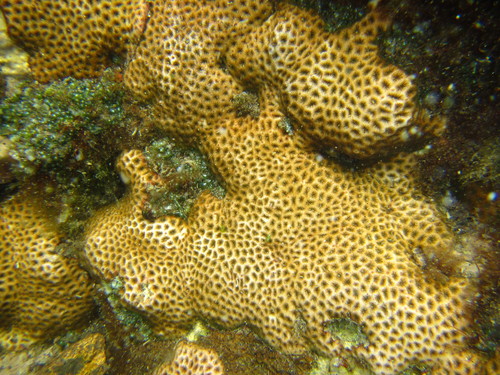
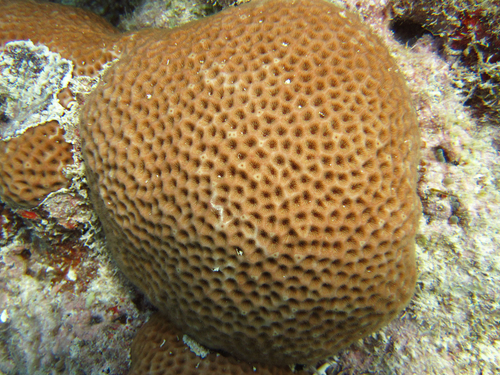
Siderastrea siderea, first described by Ellis & Solander in 1786, is a colonial coral. Mature colonies form low dome-shaped or boulder-shaped structures that sit on the seabed, with a smooth dimpled surface that can reach up to 2 metres (6 ft 7 in) across. Young colonies grow as encrusting forms over substrates. The corallites—calcareous cup-shaped depressions that hold the coral polyps—are about 5 millimetres (0.20 in) wide, and each has around 50 to 60 small ridges called septa. This coral is generally reddish brown in color. It is often confused with the closely related lesser starlet coral (Siderastrea radians), but Siderastrea radians is typically smaller, has deeper, more angular corallites, and each corallite has only 30 to 40 septa. Siderastrea siderea, commonly called the massive starlet coral, is distributed in the Caribbean Sea, the northern Gulf of Mexico, and along the coasts of southern Florida, the Bahamas, and Bermuda. It can occur at depths as great as 40 metres (130 ft), but it is most common in water less than 10 metres (33 ft) deep. It grows on rocks in a range of reef environments, and is not found in tidal pools or muddy areas. The IUCN Red List of Threatened Species lists massive starlet coral as critically endangered. It is moderately susceptible to coral bleaching, but is able to recover when environmental conditions improve.