About Siderastrea radians (Pallas, 1766)
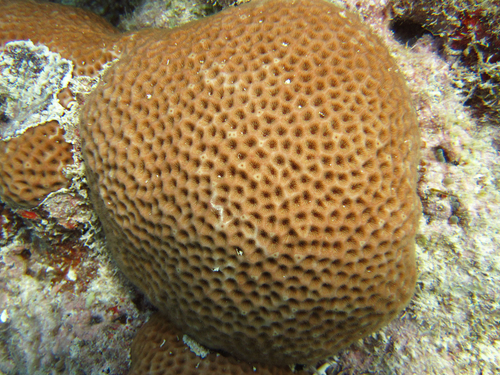
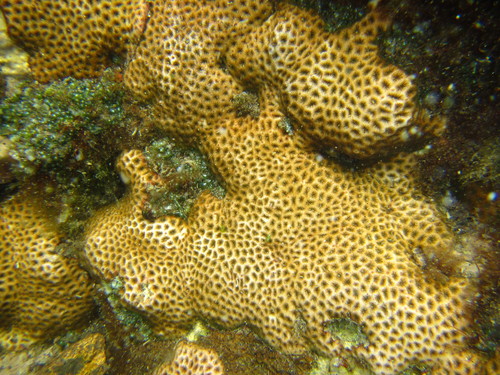
Siderastrea radians, also known as the lesser starlet coral, grows either as an encrusting layer or in small, dimpled hummocks that can reach 30 centimetres (12 inches) across, though most colonies are much smaller. Occasionally, it forms small calcareous pebbles that move freely in seagrass meadows, or loose flat discs in shallow rocky areas. Its corallites (the cup-shaped structures that hold individual polyps) are not circular; instead they are triangular or four-sided, deep, and have 30 to 40 small ridges called septa. The interior of each corallite is dark, which contrasts with the pale greyish, greenish, or light brown surface of the coral colony. The polyps stay retracted inside their corallites during the day, but emerge at night to extend their tentacles to feed. Each tentacle tip has a small knob of stinging cnidocytes. The lesser starlet coral can be mistaken for its close relative the massive starlet coral (Siderastrea siderea), but S. siderea typically grows at greater depths, reaches a larger size, and has shallower, more rounded corallites that each have 50 to 60 septa. Siderastrea radians is common in tropical regions of the western Atlantic Ocean, found at depths of less than 25 metres (82 ft), and is most abundant in water less than 10 metres (33 ft) deep. Its range stretches from Bermuda, the Bahamas, Florida, and the Caribbean Sea south to Brazil, and it also occurs in the eastern Atlantic off the coast of Africa. It grows on rocks in a variety of reef habitats, and can tolerate silty environments and tide pools. It is an adaptable species; in the Indian River Lagoon, it has been recorded tolerating temperatures between 13 °C (55 °F) and 31 °C (88 °F), as well as a wide range of salinities.