About Sicyopus zosterophorus (Bleeker, 1856)
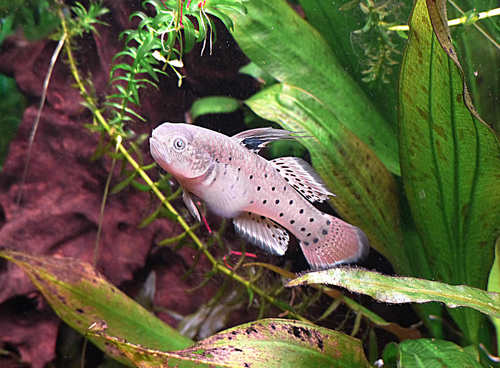
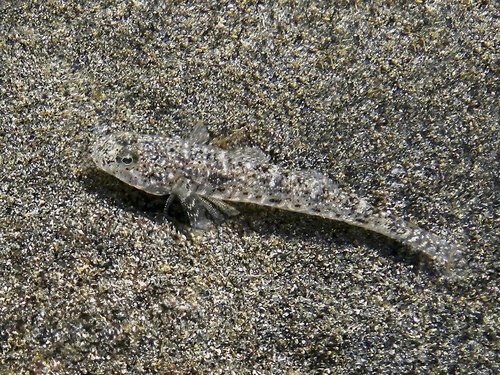
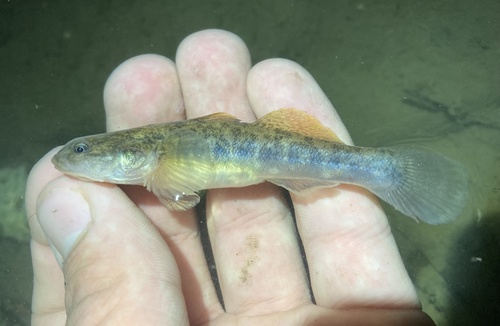
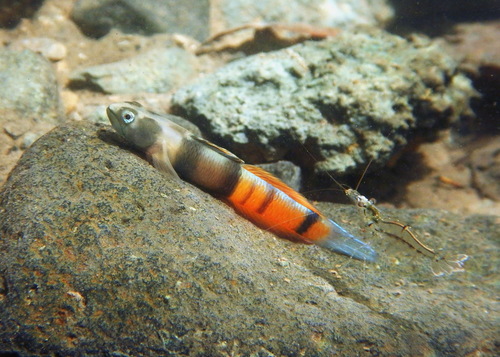
Sicyopus zosterophorus, originally described by Bleeker in 1856, has the streamlined, fusiform body shape typical of gobies that live in fast-flowing streams. Its first dorsal fin holds seven spines, all roughly equal in length, and its second dorsal fin has nine soft rays. The anal fin is made up of one spine and nine soft rays. This species typically has 33 to 34 longitudinal scales, 11 to 12 transverse scales, and 2 to 6 predorsal scales. The maxilla extends past the midline of the eye, and the species has a prominent upper jaw and fleshy lips. The gill opening is relatively small, only extending from the upper to lower margin of the pectoral fin base. The area of the head above and behind the eye has no scales. Predorsal and postpectoral scales are cycloid, while the rest of the body is covered in ctenoid scales. Males and unsexed individuals can reach a maximum standard length of 4.5 cm, while females have been recorded reaching up to 4.2 cm in standard length. Sicyopus zosterophorus is widely distributed across the Indo-Pacific. It is found in Indonesia (including Bali, Sulawesi, New Guinea, and Halmahera), Timor-Leste, the Philippines, Papua New Guinea, Taiwan, Palau, mainland China, and southern Japan (including Yaku-shima, Iriomote, and Okinawa). The species also occurs in northern Australia and several Pacific island groups, including the Solomon Islands, New Caledonia, Vanuatu, and Fiji. Sicyopus zosterophorus is an amphidromous goby that lives in marine, freshwater, and brackish environments, usually at depths between 0 and 5 m. Adults are most often found in rocky, steep-gradient creeks that are typically within 20 km of the sea, where substrates are dominated by bedrock with scattered rocks and boulders. These streams have clear, well-oxygenated water, very little aquatic vegetation, and occasional leaf litter, conditions that support rich biofilm growth on submerged surfaces. Members of the genus Sicyopus are highly specialized for short, tropical coastal streams, which are often located above waterfalls or cataracts. These barriers restrict access to most other fish species. Even with this isolation, S. zosterophorus may live alongside other gobies including Sicyopus cebuensis, Lentipes armatus, Sicyopterus lagocephalus, and Stiphodon surrufus, as well as invertebrates such as amphidromous Macrobrachium shrimp and neritid snails. Its ability to successfully colonize these specialized habitats is supported by morphological adaptations and a notable breeding strategy, including the capacity to climb waterfalls. Unlike many biofilm-grazing gobies, Sicyopus zosterophorus is a specialized predator whose diet consists mostly of insects, including chironomid larvae and hymenopterans. Crustaceans, plant material, and phytoplankton make up smaller portions of its diet. This dietary specialization is reflected in the species' morphology: it has conical, canine-like teeth adapted for capturing animal prey, which classifies it as a carnivorous and insectivorous fish. This selective feeding behavior also means it is not suitable for cohabitation with small live invertebrates in aquaria. In captivity, the species grows well in water with a temperature range of 22 to 26 °C, a pH of 6.0 to 7.5, and moderate water hardness (36 to 215 ppm). Increased surface agitation is required to maintain sufficient oxygen levels at higher temperatures. Sexual dimorphism is pronounced in Sicyopus zosterophorus. Adult males have elongated unpaired fins, including an extended first dorsal fin, and show distinct coloration, with darker pigmentation on the anterior portion of the body and orange to red coloring on the posterior portion. Females do not have elongated fins and have comparatively plain coloration. Males are territorial and compete with one another for access to suitable habitat and spawning opportunities, with dominance interactions taking place particularly when multiple males occupy the same stretch of stream. The species follows a complex amphidromous life cycle, a reproductive strategy shared with other members of the subfamily Sicydiinae. Adults live and reproduce in freshwater streams, where spawning takes place. After hatching, larvae are carried passively downstream to the sea, where they go through an obligate pelagic larval phase in marine conditions. After this developmental period, postlarvae return to freshwater and migrate upstream, often climbing steep gradients and, in some cases, climbing over waterfalls or other physical barriers before reaching adult habitats. Analysis of otolith microstructure shows that the average pelagic larval duration is approximately 55 days, after which metamorphosis occurs as the larvae recruit into freshwater. If larvae do not reach the marine environment within a short period after hatching, survival is unlikely, which demonstrates how strongly early development depends on marine conditions. Courtship behavior and occasional spawning have been recorded in the wild and in captivity, but successful fry rearing has never been achieved for Sicyopus species in aquaria. This is generally attributed to their amphidromous reproductive strategy and the requirement for a marine larval phase, which is difficult to replicate under captive conditions. Amphidromy is thought to provide several ecological advantages. It has been hypothesized that marine larval dispersal makes it easier for the species to colonize newly formed islands, especially in volcanic regions, and allows recolonization of freshwater systems after disturbances such as volcanic eruptions or extreme hydrological events. This strategy may also represent a trade-off: adults benefit from reduced predation pressure in freshwater habitats, despite the lower diversity of available food resources compared to marine environments.