About Sibirionetta formosa (Georgi, 1775)
This duck species, commonly called the Baikal teal, measures 39 to 43 centimetres (15 to 17 inches) in length. It is slightly larger and has a longer tail than the common teal; it has a height of 11.75 to 15.75 inches and an average weight of 1 pound.
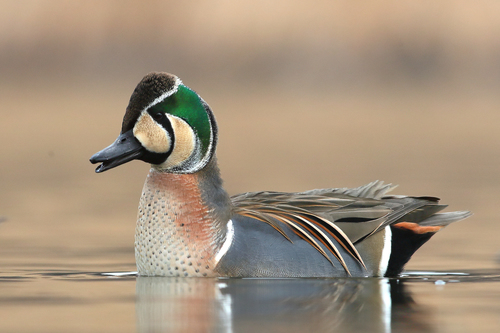
The breeding male has an unmistakable appearance: it has a dark crown, a striking green nape, yellow and black auriculars, neck, and throat. Its breast is light brown with dark spots, and its grey sides are marked with white bars on both the front and rear.
The female looks similar to the female green-winged teal, but has a longer tail. It also has a distinctive white spot at the base of the bill, a white throat that extends at an angle to the back of the eye, and a distinct light eyebrow bordered by a darker crown. The female's underwing is similar to that of the green-winged teal, but has a darker leading edge. Its green speculum has an indistinct cinnamon-buff inner border. Some individuals classified as females have "bridle" markings on their faces, but researchers suggest that at least some, if not all, of these bridled individuals are actually juvenile males.
Juveniles have plumage similar to that of adult females, and can be distinguished from common teal by their pale loral spot. In non-breeding (eclipse) plumage, the breeding male (drake) looks more similar to the female, but its plumage is a much richer reddish-brown (rufous) colour.
This is a migratory duck species. It breeds in the forest zone of eastern Siberia, with a range extending from the Yenisey basin eastward to Kamchatka, northern Koryak, eastern Magadan Oblast, northern Khabarovsk Krai, southeastern and northern Sakha, east central Irkutsk Oblast, and northern Krasnoyarsk Krai. It breeds in pools located at the edge of tundra and within swampy forests. It winters in South Korea, Japan, Taiwan, and northern and eastern China. In China, its winter range stretches from Beijing down the coast to the Vietnam border, and extends west to Yunnan, then north to Chongqing and Henan. In winter, it occurs on lowland fresh waters.