About Shortia galacifolia Torr. & A.Gray
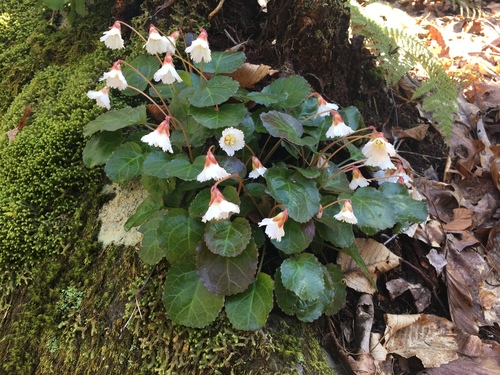
Shortia galacifolia Torr. & A.Gray produces creamy-white flowers from late March to May. Seedlings emerge in late July and early August, approximately six weeks after its capsules mature. This species spreads via stolons that grow shallow roots. It prefers loamy soil that contains some sand, clay, or both, along with soils with high humus content, and grows best in areas that receive 140–200 centimeters (55–79 inches) of annual rainfall. Plants can only tolerate 2–3 hours of bright midday light per day, and the species overall prefers shaded growing conditions. Its leaves are orbicular with wavy edges and a heart-shaped base. Its seeds are slender, oval, and colored light to medium brown. Stalks grow to 13–15 centimeters (5–6 inches) in height. Young plants are usually found within 1.5 meters (4.9 feet) of mature plants, though they have been recorded growing as far as 6 meters (20 feet) away. Within its small native range, Shortia galacifolia is always found along rivers and in sloping gorges, in areas that show signs of natural or human-caused disturbance including mudslides, erosion, windthrow, and logging. It often forms a dense mat that can prevent the seeds of other plant species from embedding in soil and germinating. Its decayed vegetative matter may also be toxic to other species. As a result, it is often the only ground cover species, or one of very few, present in the areas where it grows. It occurs at elevations ranging from 185–625 meters (607–2,051 feet), and its elevation distribution pattern varies widely between different watersheds. Common associated tree species and genera are Tsuga canadensis (eastern hemlock), Betula lenta (sweet birch), Acer rubrum (red maple), Liriodendron tulipifera (yellow poplar), Liquidambar styraciflua (sweetgum), and Fagus (beech genus). It is less commonly found growing alongside Quercus prinus (chestnut oak), Quercus alba (white oak), Pinus strobus (eastern white pine), Oxydendrum (sourwood), and Robinia (locust tree). Common associated understory species are Rhododendron maximum (greater rhododendron) in moister habitats and Kalmia latifolia (mountain laurel) in drier habitats. Several factors have led to Shortia galacifolia being an endemic relict species: it only reproduces successfully in disturbed areas, and the light and soil conditions that benefit it become unfavorable as forest canopy and understory regrow. This species has been successfully cultivated as far north as Grand-Métis, Quebec.