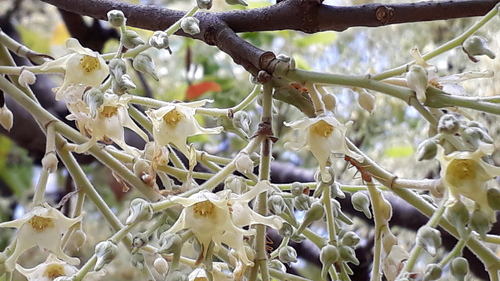
About Shorea robusta Gaertn.
Shorea robusta Gaertn. (commonly called sal, also known as sakhua in northern India) is a large tree that can reach up to 40 meters (130 feet) tall, with a trunk diameter of up to 2 meters (6.6 feet). Its leaves are 10–25 cm long and 5–15 cm broad. In wetter growing regions, sal is evergreen; in drier regions, it is dry-season deciduous, shedding most of its leaves between February and April, and producing new leaves in April and May. It is the state tree of two Indian states: Chhattisgarh and Jharkhand. This tree is native to the Indian subcontinent, growing south of the Himalaya, with a range extending from Myanmar in the east to Nepal, India and Bangladesh. In India, its range stretches from Chhattisgarh, Assam, Bengal, Odisha and Jharkhand west to the Shivalik Hills in Haryana, east of the Yamuna River. Its range also extends through the Eastern Ghats, and to the eastern Vindhya and Satpura ranges of central India. Where it grows, it is often the dominant tree in local forests. In Nepal, Shorea robusta is found mostly across the east-west Terai region, particularly in the Sivalik Hills (Churia Range) in the subtropical climate zone; dense forests of large mature sal trees grow in many Nepalese protected areas including Chitwan National Park, Bardia National Park and Shuklaphanta National Park. It also grows in the lower belt of Nepal's Hilly region and Inner Terai. Sal is one of the most important sources of hardwood timber in India. Its wood is hard and coarse-grained; it is light in color when freshly cut, but darkens to deep brown with exposure. The wood is resinous, durable, and popular for construction work, though it does not work well for planing or polishing. It is especially well-suited for making door and window frames. Dry sal leaves are a major raw material for producing leaf plates and bowls known as patravali in India and Nepal; after use, these leaf items are easily eaten by goats and cattle. In Nepal, sal leaves are used to make local serving plates and vessels called tapari, doona and bogata, which are used to serve rice and curry. However, the use of these natural disposable serving items has dropped sharply over the last decade. Resin from the sal tree is called sal dammar or Indian dammar, and is known as ṛla in Sanskrit. It is used as an astringent in Ayurvedic medicine, burned as incense in Hindu ceremonies, and used to caulk boats and ships. Sal seeds and fruit are a source of lamp oil and vegetable fat; extracted seed oil can be refined for use as cooking oil.

