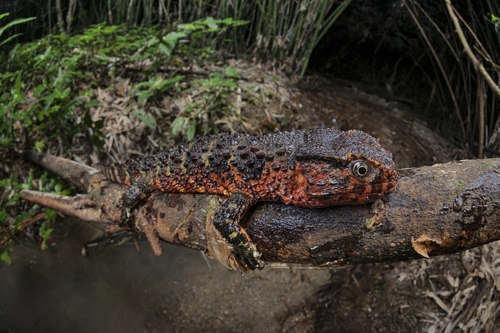
About Shinisaurus crocodilurus Ahl, 1930
The Chinese crocodile lizard, with the scientific name Shinisaurus crocodilurus Ahl, 1930, is a semiaquatic anguimorph lizard. It is found only in cool forests across southeastern China and northeastern Vietnam. This species spends much of its time in shallow water, or on overhanging branches and vegetation, where it hunts prey including insects, snails, tadpoles, and worms. Captive individuals may be fed baby mice. It is a rare, little-studied lizard, and is listed in CITES Appendix II, which regulates international trade of its specimens. This species is the only member of the monotypic genus Shinisaurus, and the only living member of the lizard clade Shinisauria, whose fossil record extends back to the Early Cretaceous over 120 million years ago. Surviving subpopulations of Chinese crocodile lizards primarily occupy isolated fragments of habitat in Guangxi and Guangdong provinces of southeastern China. The recognized Vietnamese subspecies occurs only on Yên Tử Mountain in Quảng Ninh and Bac Giang provinces of northeastern Vietnam. Chinese crocodile lizards live along clear streams within subtropical broadleaf evergreen forests. They habitually prefer remote streams in undisturbed areas such as mountain ridges and dense forests. This species lives in a relatively cool, monsoonal climate at moderately high elevations, ranging from 200 to 1,500 meters (660 to 4,920 ft) above sea level. Their preference for open, less densely vegetated habitat aligns with their antipredator strategy of fleeing instead of fighting. They use tree holes, rocks, and vegetated perches for shelter, and are rarely found exposed on the forest floor. On average, Chinese crocodile lizards reach full maturity and become able to reproduce by age 3. They are viviparous lizards, giving birth to 2 to 12 fully developed, independently viable offspring every spring, with no maternal care required after birth. Gestation lasts up to 9 months. Females are able to breed annually. Courtship typically begins at the end of winter, and breeding most often occurs in summer, mainly in July and August. Pre-copulation behavior usually starts when adult males develop more vibrant coloration. Males perform courtship behaviors including head-nodding and approaching females. Successful copulation begins when the male approaches and bites the female on the neck. He then moves to position his body on top of the female, and secures his tail below hers. This position maintains alignment for cloacal contact between the pair. After ejaculation, the male releases his bite on the female's neck and lets her go.

