About Setophaga pinus (Linnaeus, 1766)
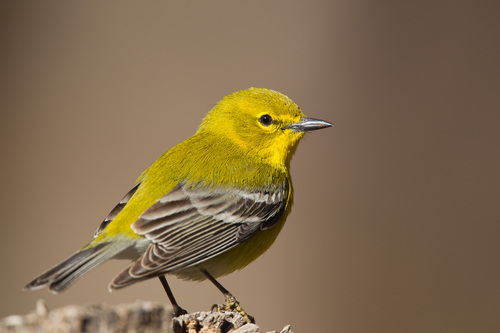
This species, the pine warbler, has the following physical description: all individuals have white bellies, two white wing bars, dark legs, thin, relatively long pointed bills, and yellowish 'spectacle' markings around the eyes. Adult males have olive-colored upperparts and bright yellow throats and breasts, while females and immature birds have olive-brown upperparts, and paler throats and breasts. Adult male pine warblers bear a close resemblance to yellow-throated vireos, which can lead to confusion when identifying the species. The song of the pine warbler is a musical trill, and its calls are slurred chips. In terms of distribution and habitat, the pine warbler breeds in open pine woods across eastern North America. Populations in southern Florida are permanent residents. Some individuals migrate to spend the non-breeding season in northeastern Mexico, as well as islands in Bermuda and the Caribbean. The first recorded sighting of this species in South America was a vagrant wintering female observed at Vista Nieve, Colombia on 20 November 2002. This individual was foraging as part of a mixed-species feeding flock that also included wintering Blackburnian warblers and Tennessee warblers.