About Setophaga petechia (Linnaeus, 1766)
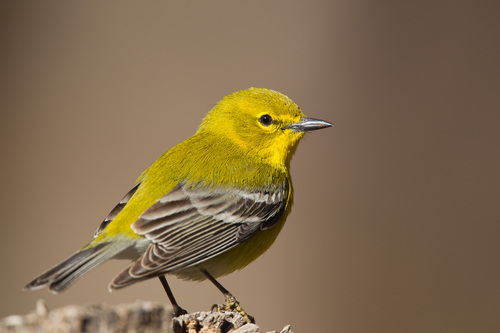
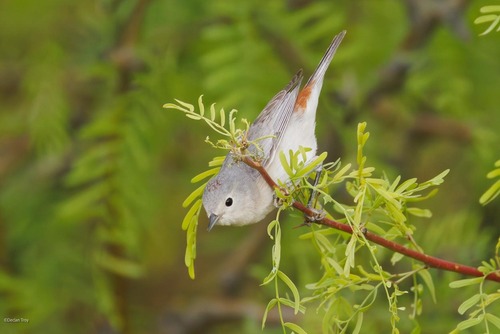
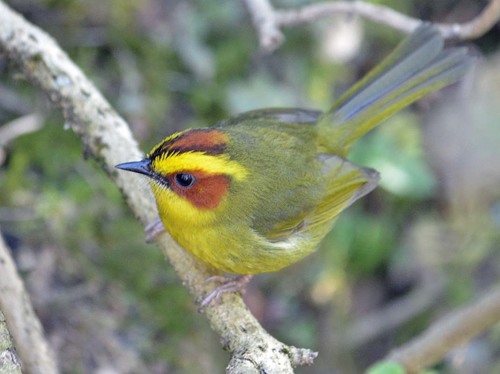
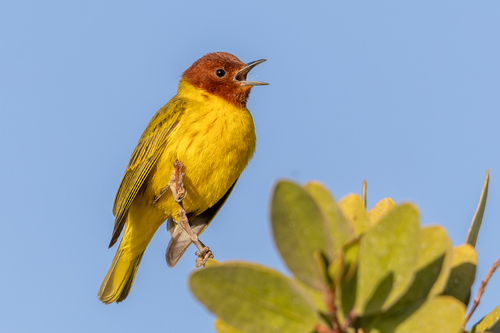
The scientific name of this species is Setophaga petechia (Linnaeus, 1766). Apart from breeding-plumage males and overall body size, all subspecies of this warbler are very similar in appearance. Winter adults, females, and immature birds all have greenish-yellow uppersides and duller yellow undersides. Young males quickly develop breast coloration, and head coloration in subspecies where that trait occurs. Females are somewhat duller overall, most noticeably on the head. Across all plumages and subspecies, the flight feathers (remiges) and tail feathers (rectrices) are blackish olive with yellow edges; this sometimes forms an indistinct wing band on the flight feathers. The eyes and short thin beak are dark, while the feet range from light to dark olive-buff. There are 35 total subspecies of S. petechia, which can be split into three main groups based on breeding male head coloration. Some taxonomic treatments treat each of these groups as separate species, while others treat the aestiva group (yellow warbler) as a distinct species separate from S. petechia (the mangrove warbler, which also includes the golden warbler group). This second treatment is currently accepted by the International Ornithological Congress World Bird List. Depending on subspecies, S. petechia measures 10 to 18 cm (3.9 to 7.1 in) in total length, with a wingspan of 16 to 22 cm (6.3 to 8.7 in). Body weight ranges from 7 to 25 g (0.25–0.88 oz), varying by subspecies and migration status. The global average weight is around 16 g (0.56 oz), but most breeding adults from United States populations weigh only 9–10 g (0.32–0.35 oz). Standard measurements across all subspecies are: wing chord 5.5 to 7 cm (2.2 to 2.8 in), tail 3.9 to 5.6 cm (1.5 to 2.2 in), bill 0.8 to 1.3 cm (0.31 to 0.51 in), and tarsus 1.7 to 2.2 cm (0.67 to 0.87 in). Breeding season males of this species are generally the yellowest warblers wherever they are found. They are brilliant yellow below and greenish-golden above, with usually a few wide, somewhat washed-out rusty-red streaks on the breast and flanks. These markings are the origin of the specific epithet petechia, which translates roughly to "liver spotted". Subpecies generally vary in brightness and size following Bergmann's and Gloger's Rule. The 17-subspecies petechia (golden warbler) group is generally resident in West Indies mangrove swamps, though local seasonal movements can occur. For example, the subspecies S. p. eoa was found to be decidedly scarce on Grand Cayman and apparently absent from Cayman Brac in November 1979, even though it had been a very common breeder in the area around ten years earlier, and was not frequently recorded during the 1972/1973 winters. This pattern indicates these birds disperse to other areas outside the breeding season. The Cuban golden warbler (S. p. gundlachi) barely reaches the Florida Keys, where it was first recorded in 1941, and had established a resident breeding population there by the mid-20th century. While individual birds may stray further north, their distribution is limited by the absence of mangrove habitat. Golden warbler group birds are generally small, usually weighing around 10 g (0.35 oz) or less, and sometimes as little as 6.5 g (0.23 oz). Breeding males in this group differ from American yellow warbler breeding males by having a rufous crown, hood, or mask. Races within this group vary in the extent and hue of the head patch. The 12-subspecies erithachorides (mangrove warbler) group tends to be larger than the other two S. petechia groups, averaging 12.5 cm (4.9 in) in length and 11 g (0.39 oz) in weight. This group is resident in mangrove swamps along coastal Middle America and northern South America; the subspecies S. p. aureola occurs on the oceanic Galápagos Islands. Breeding males of this group differ from American yellow warbler breeding males by having a rufous hood or crown. Races within this group vary in the extent and hue of the hood, and overlap extensively with the golden warbler group in this trait. The six-subspecies aestiva (American yellow warbler) group breeds across most of temperate North America as far south as central Mexico, in open, often wet woodland or shrub habitat. It is migratory, wintering in Central and South America, and is a very rare vagrant to western Europe and Scandinavia. American yellow warblers breed across most of North America from tundra southward, excluding the far Southwest and the Gulf of Mexico coast. They winter south of their breeding range, from southern California to the Amazon region, Bolivia, and Peru. Mangrove and golden warbler groups occur further south, reaching the northern Andes. American yellow warblers arrive in their breeding range in late spring, generally around April or May, and begin moving to wintering grounds as early as July, as soon as their young have fledged. Most individuals stay a little longer, and by the end of August the bulk of northern populations have moved south, though some may remain almost until fall. At least in northern Ohio, yellow warblers do not linger, and leave on the same schedule they followed 100 years ago. The breeding habitat of American yellow warblers is typically riparian or other moist land with abundant growth of small trees, especially willows (Salix). The other two subspecies groups, as well as wintering American yellow warblers, primarily inhabit mangrove swamps and similar dense woody vegetation. Less preferred habitats include shrubland, farmlands, and forest edges. American yellow warblers in particular will enter suburban or sparsely settled areas, orchards, and parks, and often breed in these locations. Outside the breeding season, these warblers are usually found in small groups, but during the breeding season they are fiercely territorial and will chase away any intruder of their own species that enters their territory. Roughly 60% of their diet is made up of caterpillars. They also eat wasps, mayflies, moths, mosquitoes, beetles, damselflies, treehoppers, other insects, insect larvae, and spiders. They capture prey by gleaning from shrubs and tree branches, and by hawking prey that attempts to fly away. They also eat other invertebrates and some berries and similar small juicy fruits; fruits are eaten especially by American yellow warblers during the winter. Yellow warblers are one of several insectivorous bird species that reduce populations of coffee berry borer beetles in Costa Rican coffee plantations by 50%. Caterpillars are the staple food for nestlings, with some types – for example, those of geometer moths (Geometridae) – preferred over others. The predators of yellow and mangrove warblers are those typical of small, tree-nesting passerines, including snakes, foxes, birds of prey, and many other taxa. On average, adult American yellow warblers have a 50% annual survival rate. In southern populations, by contrast, around two-thirds of adults survive each year. On average, fewer than one out of three American yellow warbler nests experiences any form of predation, while two out of three mangrove and golden warbler nests are affected by predation. Snakes, including the blue racer (Coluber constrictor foxii) and common garter snake (Thamnophis sirtalis), are significant nest predators, feeding on nestlings and fledglings as well as sick or distracted adult warblers. Corvids such as the American crow (Corvus brachyrhynchos) and blue jay (Cyanocitta cristata), and large climbing rodents, most notably the American red squirrel (Tamiasciurus hudsonicus), also attack nests in this way. Carnivores, particularly members of Musteloidea, including the striped skunk (Mephitis mephitis), long-tailed weasel (Neogale frenata), common raccoon (Procyon lotor), red fox (Vulpes vulpes), and domestic or feral cats, are similarly opportunistic predators. All of these predators pose little threat to agile non-nesting adult warblers, which are hunted by certain small and agile birds such as the American kestrel (Falco sparverius), Cooper's hawk (Accipiter cooperii), and sharp-shinned hawk (A. striatus). Other avian predators of adult warblers include peregrine falcons (Falco peregrinus) and merlins (F. columbarius). Owls such as great horned owls (Bubo virginianus) and eastern screech owls (Megascops asio) have been recorded attacking yellow warblers of all ages at night. These New World warblers rarely mob predators. The main exception are cowbirds, which are significant brood parasites. The yellow warbler is a regular host of the brown-headed cowbird (Molothrus ater), with around 40% of all nests experiencing attempted or successful parasitism. By contrast, tropical populations are less frequent hosts of the shiny cowbird (M. bonariensis), with only 10% of nests affected. This may be because shiny cowbird eggs and nestlings are slightly larger, and are less likely to survive being fed by the much smaller warbler, compared to brown-headed cowbirds. The yellow warbler is one of the few passerine species proven to recognize when cowbird eggs have been laid in its nest. After recognizing a cowbird egg, the warbler will often smother it in a new layer of nesting material. It usually does not attempt to save any of its own eggs that have already been laid in the parasitized nest, and instead produces a replacement clutch. Sometimes the parent birds will abandon a parasitized nest entirely and build a new nest. Unlike some cuckoos, cowbird nestlings do not actively kill the host bird's nestlings, and mixed broods of Setophaga and Molothrus can successfully fledge. Even so, fledging success for yellow warbler nests is usually lowered by cowbird parasitism, due to the additional stress of raising a much larger nestling. Aside from predation, causes of mortality are not well studied. The maximum recorded lifespan of wild yellow warblers is around 10 years. A wintering American yellow warbler examined near Turbo, Colombia was not infected with blood parasites, unlike other species included in the same study. It is unclear whether this finding is significant, but most wintering birds in this region lacked blood parasites.