About Setophaga occidentalis (J.K.Townsend, 1837)
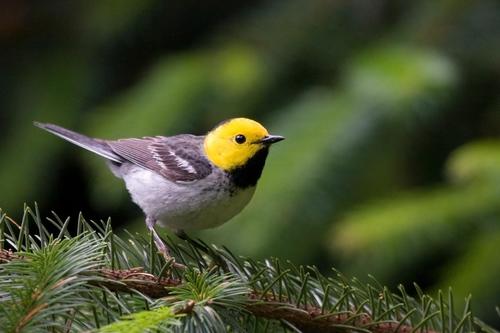
This species, the hermit warbler, has the scientific name Setophaga occidentalis (J.K.Townsend, 1837). Hermit warblers are dark gray on their upperparts and white below, with black streaks on their flanks. Their wings feature two diagonal white wing bars. Most of the hermit warbler's head is yellow. Adult males have a solid dark black throat, while females have far less black on their throat bib, and immature birds have no black on the throat at all. Both adult males and females reach 5.5 inches (14 cm) in total length, weigh between 0.3 to 0.5 oz (8.5 to 14.2 g), and have a wingspan of 7.9 in (20 cm). Hermit warblers are common, but extremely shy, birds that live in open coniferous forests. They also use wetter areas for nesting, and occupy a variety of mountain habitats. Their summer breeding range covers most of the U.S. west coast, extending north to Washington. These migratory birds sometimes winter in southwestern California, but most winter in Central America as far south as Panama. Most other details of their nesting habits remain unknown. During migration, hermit warblers can be found in both coniferous and deciduous habitats, along wooded areas bordering water, in desert oases, and in suburban areas. They most frequently occur in tall coniferous forest stands, including those dominated by Douglas fir, pine, and redwood, as well as mountainous areas. Nests of the hermit warbler are neat, cup-shaped structures built from stems, grass, twigs, and pine needles. Nests are placed near the tip of a branch high up in a conifer tree. The female lays between three and five eggs per clutch; the eggs are white with heavy brown and lilac speckles. Most other details of incubation habits are unknown.