About Setophaga magnolia (A.Wilson, 1811)
Setophaga magnolia, commonly called the magnolia warbler, is a moderately small New World warbler. This species measures 11 to 13 cm (4.3 to 5.1 in) in total length, with a wingspan of 16 to 20 cm (6.3 to 7.9 in). Adult body mass typically ranges from 6.6 to 12.6 g (0.23 to 0.44 oz), though weights have been recorded up to 15 g (0.53 oz) before migration. Standard measurements for the species are: wing chord 5.4 to 6.4 cm (2.1 to 2.5 in), tail length 4.6 to 5.2 cm (1.8 to 2.0 in), bill length 0.8 to 1 cm (0.31 to 0.39 in), and tarsus length 1.7 to 1.85 cm (0.67 to 0.73 in).
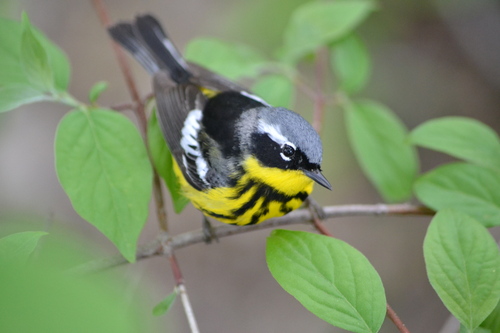
The magnolia warbler can be identified by its distinct coloration. Breeding males typically have white, gray, and black backs with yellow on the sides; yellow and black-striped underparts; white, gray, and black foreheads and beaks; distinct black tails with white stripes on the underside; and clear defined white wing bars. Breeding females usually share the same general color pattern as males, but their coloration is much duller. Immature magnolia warblers also have the same dull coloration as breeding females. The yellow and black-striped underparts help distinguish breeding males from similar species like the prairie warbler and Kirtland's warbler, which have breeding ranges south and east of the magnolia warbler's.
The magnolia warbler breeds in boreal forests across northern parts of the Great Lakes, New England, and Appalachian regions of the United States, as well as across most of central and eastern Canada. It breeds in dense forests, most often found among the branches of young, densely packed coniferous trees. In winter, the species migrates through the eastern and central half of the United States, reaching as far west as Oklahoma and Kansas, to its wintering grounds in southern Mexico, Central America, and the Caribbean. During migration, magnolia warblers can be found in a variety of woodland types.
Magnolia warblers go through multiple molts over their lifetime. The first molts begin while young birds are still in the nest, and all other molts occur on or near their breeding grounds. Their annual cycle follows the order: molt, breed, care for offspring, then migrate. Chicks hatch after a two-week incubation period, and can fledge from the nest after close to another two weeks once their feathers have developed. After approximately one month, chicks leave the nest to begin living independently, as they are a solitary species. Magnolia warblers typically live up to seven years.
Male magnolia warblers arrive at breeding grounds approximately two weeks before females. After females arrive, both sexes cooperate to build the nest over a period of one week. Due to the difficulty of finding nests in dense forest undergrowth, it is not known whether the species reuses nests between breeding seasons or builds new nests each year. Nests are built in preferred fir species, including balsam fir (Abies balsamea) and white spruce (Picea glauca). Nests are constructed from grass, twigs, and horsehair fungus, and are relatively small, shallow, circular-shaped structures that barely exceed 10 cm in any dimension. Nests are usually placed close to the ground, most commonly within the lowest three meters of the fir.
Females typically lay three to five eggs per breeding season, and do not begin incubation until all eggs are laid. Incubation, performed by the female, lasts approximately two weeks until the eggs hatch. The female also broods (warms) newborn chicks by sitting on the nest, and feeds newborn chicks most often, though males will also feed offspring at times. Because males contribute equally to feeding chicks and expend significant energy foraging for their young, they are considered monogamous. To keep the nest clean, females eat the fecal sacs of newborn chicks; as chicks grow older, both parents simply remove the sacs from the nest. Young magnolia warblers are ready to leave the nest by ten days of age.