About Setophaga graciae (S.F.Baird, 1865)
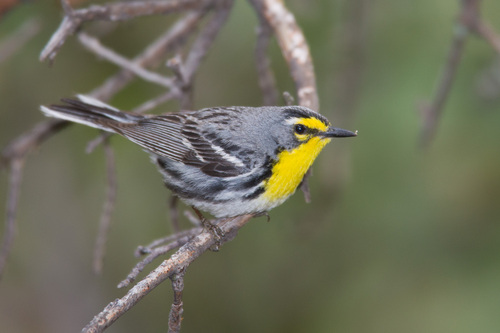
Grace's warbler, scientifically named Setophaga graciae (S.F.Baird, 1865), is a small bird measuring 11 to 13 cm in length. Its upperparts are mostly gray, with broken black streaks across the back and flanks and two white wing bars. The throat and breast are vibrant yellow, while the rest of the underparts are white. It has a yellow half-eye ring below the eye and a long yellow eyebrow stripe that starts at the base of the beak, runs above the eye, and fades to white after passing the eye. Grace's warblers breed across a range from the southwestern United States to Nicaragua, and they winter within their breeding range from northeastern Sinaloa and northwestern Durango southward. They are almost always found in pine forests, even during migration. At the northern end of their range, which includes southern Nevada, Utah, and southwestern Colorado, they occur in spruce-fir forest. They prefer open, "parklike" woods; in some areas such as northern Arizona, they favor an understory of Gambel's oak. In the United States and northern Mexico, they typically occur at altitudes between 1,800 and 2,700 meters (5,900 to 8,900 ft); further south, they can occur as low as 250 m. They are common in some localities; in areas of Nicaragua's Mosquitia where Caribbean pine is the only tree, Grace's warblers may be the only bird observed. Four subspecies of Setophaga graciae are recognized, including the nominate subspecies. The nominate subspecies, Setophaga graciae graciae, ranges from southern Nevada, southern Utah, southwestern Colorado, northern New Mexico, and western Texas south through eastern Sonora and western Chihuahua. Setophaga graciae yaegeri (A. R. Phillips & Webster, 1961) occurs in west-central Mexico, from southern Sinaloa, Durango, and Zacatecas south to Jalisco and Colima. Setophaga graciae remota (Griscom, 1935) is found along the Pacific coast from Michoacan through Guerrero, Oaxaca, and Chiapas, extending into Guatemala, El Salvador, Honduras, and northern Nicaragua. Setophaga graciae decora (Ridgway, 1873) is found in Belize.