About Setophaga caerulescens (J.F.Gmelin, 1789)
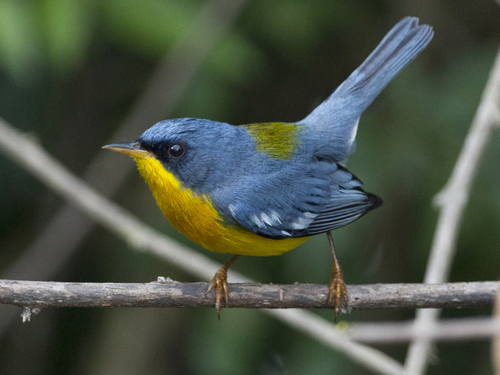
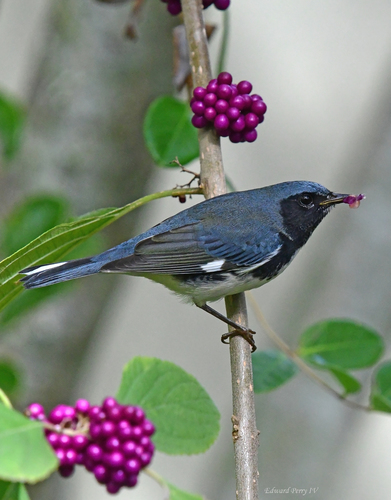
The black-throated blue warbler, Setophaga caerulescens, measures 13 cm (5.1 in) in length, weighs 8.4–12.4 g (0.30–0.44 oz), and has a wingspan ranging from 19–20 cm (7.5–7.9 in). This species is strongly sexually dimorphic. Adult males have deep blue upperparts, white underparts, and black throats, faces, and flanks. Immature males are similar to adults, but have greener upperparts. Females have olive-brown upperparts, light yellow underparts, darker wings and tail, a gray crown, and brown patches on the cheeks. Both sexes have a thin pointed bill and small white wing patches that are not always visible. Like many other warbler species, the black-throated blue warbler has colorful plumage during spring and summer, but develops drab, less distinctive plumage outside the breeding season. Even in the fall, the species can still be identified by its small white wing patches. Juveniles have brown upperparts, a creamy supercilium, and brownish spots on the throat, breast, and belly. The black-throated blue warbler's song is a buzzed zee-zee-zeeee with an upward inflection, and its call is a flat ctuk. The black-throated blue warbler is a migratory bird. It breeds in temperate mature deciduous forests or mixed coniferous-deciduous forests with thick understory, and is most often found in hilly and mountainous regions of the northeastern United States and southeastern Canada. In late summer, it migrates to tropical wooded and scrub habitats in the Greater Antilles to spend the winter. It can be seen in parks and gardens along its migration route. Nesting site requirements are more important than foraging site requirements for determining the species' overall habitat. The black-throated blue warbler is an open-nesting species that nests very close to the ground, so it chooses protected nesting sites where the risk of predation is relatively low.