About Setophaga americana (Linnaeus, 1758)
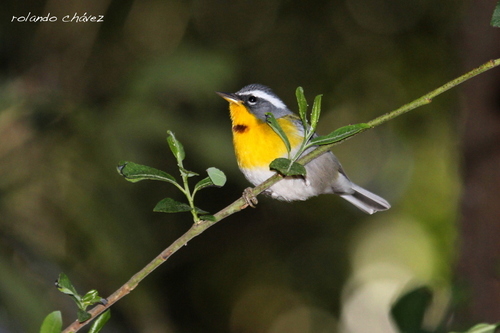
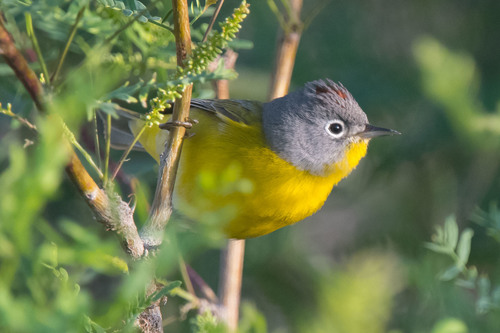
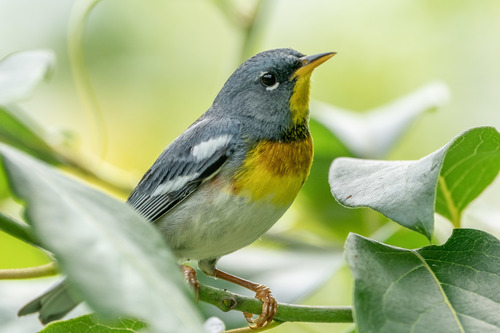
The northern parula (Setophaga americana) is one of the smallest migratory warblers native to North America. It is typically among the smallest birds in mixed feeding flocks, only outsized by kinglets and gnatcatchers. It measures 10.8 to 12.4 cm (4.3 to 4.9 in) in length, has a 16 to 18 cm (6.3 to 7.1 in) wingspan, and weighs between 5 and 11 g (0.18 to 0.39 oz). Its standard measurements are: wing chord 5.1 to 6.5 cm (2.0 to 2.6 in), tail 3.7 to 4.5 cm (1.5 to 1.8 in), bill 0.8 to 1.1 cm (0.31 to 0.43 in), and tarsus 1.5 to 1.8 cm (0.59 to 0.71 in). The species has mostly blue-gray upperparts, with a greenish back patch and two white wing bars. Its breast is yellowish, fading into a white belly. Summer breeding males have bluish and rufous breast bands and prominent white eye crescents. After the breeding season ends, individuals molt into a duller version of their breeding plumage. Females look similar but are generally duller and lack the characteristic breast bands; the unique breastband fades in males and may disappear entirely in females. The northern parula's song is a click-like trill or buzz transcribed as zeeeeee-yip, and its call is a soft chip. This is a migratory species; it winters in southern Florida, northern Central America, the West Indies, and most of the Lesser Antilles, and is a very rare vagrant to western Europe. While the species remains a common breeder across most of eastern North America, there are clear gaps in its current breeding range that were once likely occupied by breeding populations. It has been extirpated as a breeder from much of the Midwest, as well as from many areas in Massachusetts, New Jersey, Connecticut, New York, Rhode Island, and Vermont. Proposed explanations for this disappearance include habitat changes and increasing air pollution, which limited growth of the epiphytes on trees that the warbler relies on for nesting. Another explanation is clear-cutting and bog draining, which have greatly reduced the amount of suitable habitat in eastern North America. The northern parula lives in different habitats depending on season and location. It is primarily a forest-dwelling species, but northern and southern breeding populations choose different breeding habitats. In general, the species' abundance is positively correlated with higher tree species diversity, greater canopy height, and higher percent canopy cover. Northern populations breed in mature, moist coniferous forests. The species builds its pendulum nests in hanging vegetation, so it is often attracted to suspended clumps of moss or coniferous twigs, which are more abundant in moist spruce bogs or hemlock swamps. Southern populations breed in mature, moist bottomland forest where Spanish moss is common. Outside of the breeding season, the northern parula is a more generalist habitat user, and can be found in a wide variety of habitats during migration and winter, including pastures, moist, dry or wet forests, agricultural fields, and plantations. The northern parula forages mostly or entirely on terrestrial invertebrates. Its recorded prey items include spiders, damselflies, locusts, bugs, grasshoppers, aphids, beetles, caterpillars, flies, wasps, bees, and ants. Regardless of season, caterpillars and spiders are the most commonly consumed prey. During winter, the northern parula eats more beetles, and occasionally forages on berries, seeds, and nectar. The species primarily captures prey from vegetation via the hover-glean method, but it can also use a variety of other foraging methods. It may make short flights from a perch to snatch prey mid-flight, or even hang upside-down to forage. It is most often observed foraging in the mid to upper canopy levels of vegetation. While most foraging happens in arboreal vegetation, the species will occasionally forage on or around the ground as well. One northern parula collected from Augusta, Georgia was found to be a host of the intestinal acanthocephalan worm Apororhynchus amphistomi.