About Sesia bembeciformis (Hübner, 1803-1806)
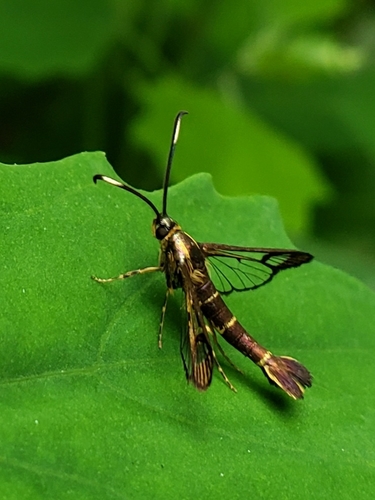
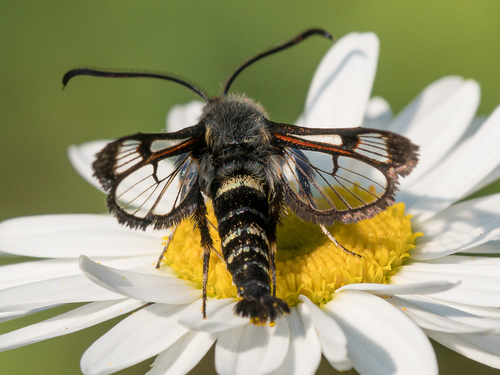
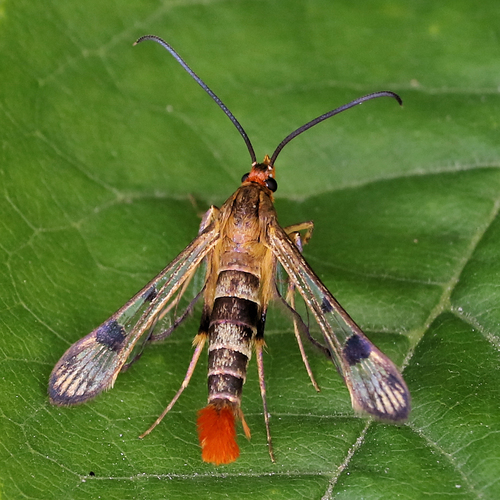
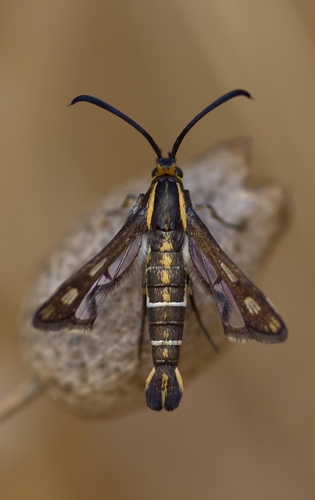
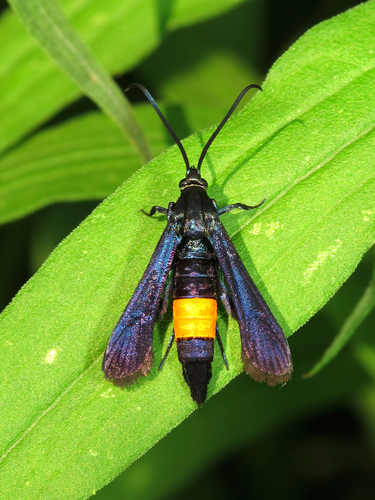
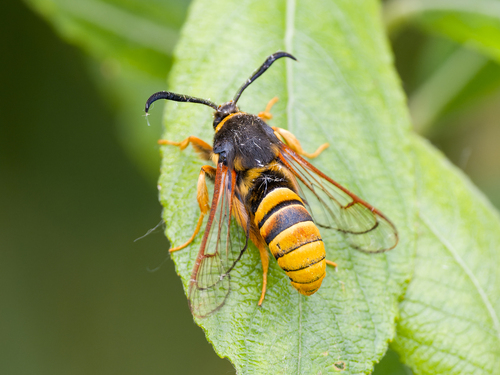
Sesia bembeciformis, commonly known as the lunar hornet moth, is a moth species belonging to the family Sesiidae. This species is found across Europe. Its wingspan measures 32–42 mm, and the forewings have a length of 15–19 mm. Like all members of the Sesiidae family, this Bembex clearwing moth resembles a hymenopteran wasp in both appearance and flight. Its wings are scaleless, transparent, narrow, and elongated in shape. Sesia bembeciformis is very difficult to distinguish from its closest related species, Sesia apiformis. The key difference is that Sesia apiformis has yellow 'epaulettes' on its shoulders located directly above the wing bases, while Sesia bembeciformis is dark in this area, with the only yellow marking being its neck ring. Sesia bembeciformis is also smaller than Sesia apiformis and has a black head. In general, female Sesia bembeciformis are considerably larger than males. This moth strongly resembles the large European hornet Vespa crabro, which is an example of defensive mimicry. Adult moths are active from June through August, and can be found resting on the trunks of willow trees. The host willow species include goat willow (Salix caprea), grey willow (Salix cinerea) and eared willow (Salix aurita). Females lay their eggs directly on willow bark. After hatching, larvae first tunnel between the tree bark and wood, and later burrow deeper into the tree stem. Larval development of this species takes 3 to 4 years to complete. The species has an overall hidden lifestyle, and adult moths only live for a short period, so it is often easily overlooked by observers.