About Seseli libanotis (L.) W.D.J.Koch
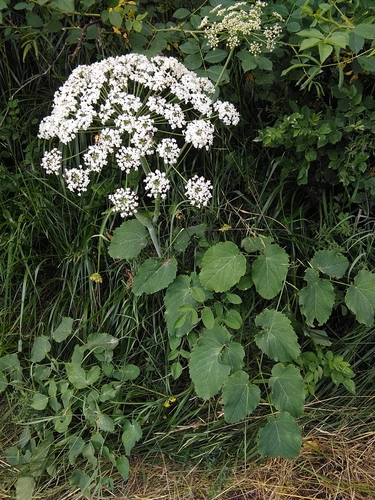
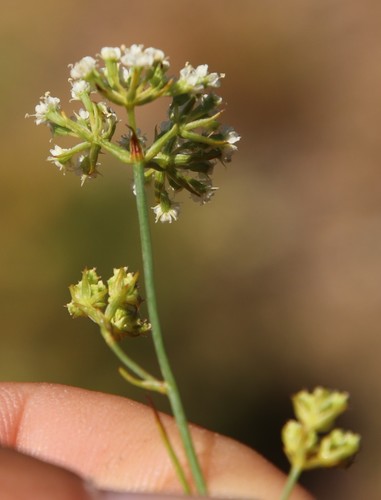
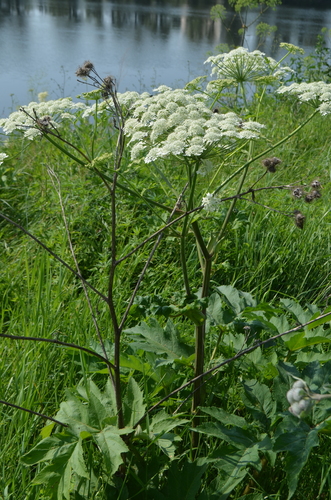
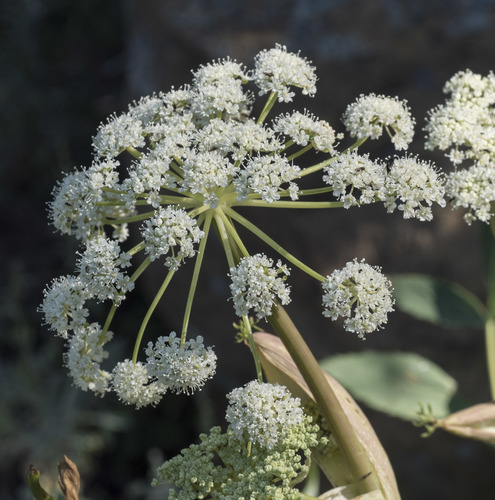
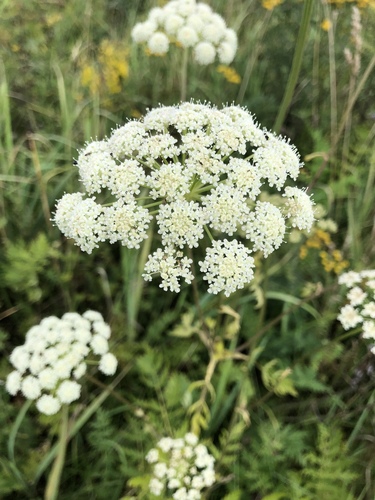
Seseli libanotis (L.) W.D.J.Koch grows 40 to 120 centimetres (16 to 47 inches) tall, with erect, branching stems. Its leaves are arranged in an alternating pattern: lower leaves have stalks, while upper leaves are stalkless. The undersides of its leaflets are bluish green. Individual flowers grow to less than 5 millimetres (0.20 inches) wide, are white, and sometimes have a slight reddish tint. Flowers are either actinomorphic or slightly irregular zygomorphic, and grow in compound umbels: each large umbel can hold up to sixty flowers, and individual umbels within the cluster form smaller secondary umbels. Its fruit is a brown, slightly hairy, flat, two-part egg-shaped schizocarp, usually 2.5 to 4 centimetres (0.98 to 1.57 inches) long. Three subspecies of this plant are recognized: S. l. intermedium, S. l. libanotis, and S. l. sibiricum. Ecologically, Seseli libanotis is usually a biennial, though it may occasionally grow as a monocarpic perennial. It flowers during the months of July and August. It favors temperate environments, and its native range covers most of northern and central Eurasia, as well as parts of North Africa, extending from England and Scandinavia to Siberia. It is particularly prevalent in the Carpathian Mountains. This species prefers rocky terrain, grassy slopes, or shrubby areas, growing in dry, well-drained soil. In Britain, all known populations of the plant grow entirely within Sites of Special Scientific Interest (SSSIs), found on chalky terrain in the Chiltern Hills and South Downs. The plant has also been introduced to Maryland in the United States, where it has been identified as invasive. It has not been evaluated by the International Union for Conservation of Nature (IUCN), but it is rare in Britain and classified as Near Threatened within the country. Along with Seseli campestre, Seseli libanotis acts as a host species for the parasitic fungus Puccinia libanotidis, also called moon carrot rust, a species in the rust genus Puccinia. P. libanotidis was long considered extinct in Britain, with no records of the species dating back to 1946, but it was rediscovered in 2009 during a study conducted by Kew Gardens. For human uses, the leaves and root of Seseli libanotis are edible. The plant is useful for honey production, and has also been used in folk medicine. Multiple studies indicate that Seseli libanotis, along with other members of the genus Seseli, has natural antimicrobial and antioxidant properties.