About Sesbania vesicaria (Jacq.) Elliott
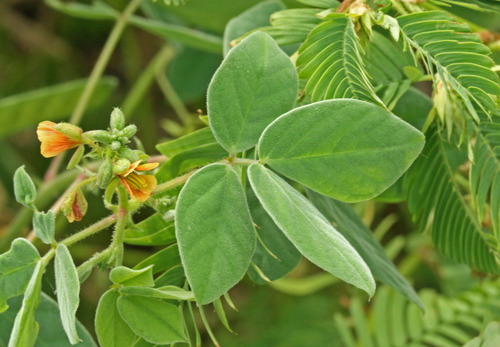
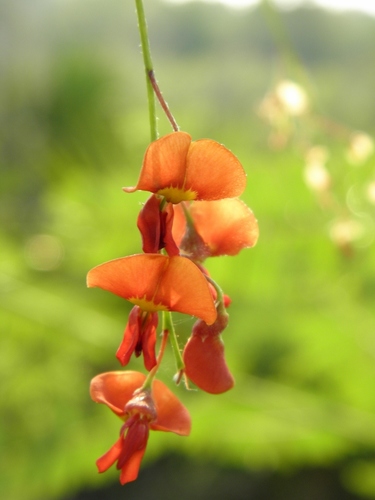
Sesbania vesicaria (Jacq.) Elliott, commonly called bag pod, grows a single tall stem reaching 4 to 8 feet in height. Its leaves are evenly pinnately compound, with 20 to 40 leaflets per leaf; each leaflet is oblong to elliptical in shape. The plant's flowers are predominantly yellow, with subtle pink or red undertones. Its seed pods are strongly beaked, and hold 1 to 3 seeds each, with 2 seeds being the most common. The seeds are bean-like, roughly oblong in outline, measuring about 1 centimeter long and 5 millimeters wide. Young seeds are green and yellowish, and darken to dark brown when they reach maturity. Sesbania vesicaria is restricted to freshwater habitats where salinity levels approach 0 ppt. It grows most often on mineral soils in wet pastures, disturbed areas, and is commonly found in abandoned rice fields. It typically grows as scattered individual plants, but can sometimes form dense colonies. It has been recorded in 10 U.S. states: Alabama, Arkansas, Florida, Georgia, Louisiana, Mississippi, North Carolina, Oklahoma, South Carolina, and Texas. Across the Atlantic and Gulf Coastal Plain, Eastern Mountains and Piedmont, and Great Plains, it grows as a facultative hydrophyte, occurring in both wetland and non-wetland areas. In the Midwest, it is classified as an obligate hydrophyte, as it almost always grows in wetland areas. Bag pod can be easily propagated by planting seeds in prepared seed beds or lightly disturbed, wet mineral soils. After emerging, seedlings thrive in very wet soil conditions, but also have an unexpected tolerance for dry soils. This species can tolerate fire, freshwater flooding, and drought, and grows well even after heavy livestock grazing following cultivation. To control unwanted populations of Sesbania vesicaria, the most effective methods are frequent mowing or application of herbicides approved for use on aquatic plants. The species has been linked to one recorded human death: in late October 2021 in South Carolina, a hiker ate some of its pods and died three days later after being hospitalized.