About Serranus tortugarum Longley, 1935
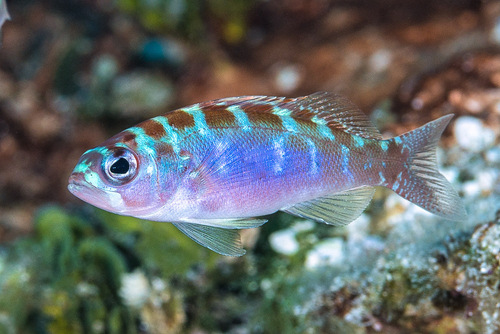
Serranus tortugarum, commonly called chalk bass, has an elongated, laterally compressed body and a pointed snout that is shorter than the eye diameter. It has three distinct spines on the gill cover, with the middle spine being straight. The margins of the preopercle are regularly serrated, and no spines are present at its angle. The dorsal fin has 10 spines and 12 soft rays, while the anal fin has 3 spines and 7 soft rays. Its caudal fin is truncate. This species has variable coloration and patterning, and can change its body color and pattern to match its environment for camouflage. The typical color of the head and body ranges from pale blue-grey to pinkish brown, with 8 narrow vertical blue-grey bars running along the upper body. The frontmost of these bars sits just behind the eye, and the rearmost sits on the base of the caudal fin; the bars extend onto the dorsal fin in the area where they overlap this fin. There is a row of 2 to 3 pale blotches on the flanks, and fin color ranges from transparent to pinkish. Chalk bass reaches a maximum total length of 8.0 centimetres (3.1 in).
This species occurs in the western Atlantic Ocean, ranging from the Bahamas and southern Florida throughout the Caribbean, and along the mainland coast from southern Mexico to Venezuela.
Serranus tortugarum inhabits areas with rock, silt, or sand substrates, at depths from 2 to 400 metres (6.6 to 1,312.3 ft), though it is most commonly found at depths less than 90 metres (300 ft). It is a social species, typically found in loose aggregations with a clear hierarchy. It is a simultaneous hermaphrodite, meaning every individual has both male and female reproductive organs at the same time, though self-fertilization has never been recorded in this species. This species practices egg parceling: long-term mating partners trade sex roles each time they spawn, which maintains an equitable allocation of reproductive resources. Chalk bass feeds primarily on zooplankton, though larger individuals have been recorded feeding on larger crustaceans, which they swallow whole. They frequently hover over sandy or rubble seabeds, and use nearby conch shells for shelter.