About Serranus tigrinus (Bloch, 1790)
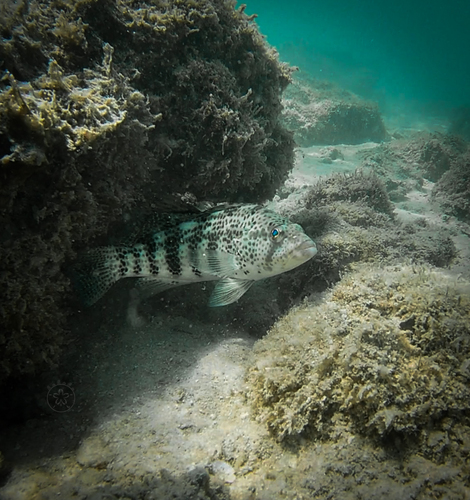
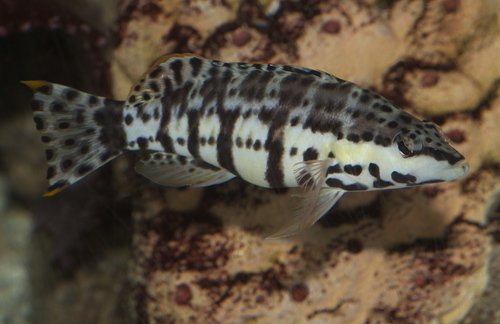
Serranus tigrinus has an elongate, laterally compressed body and a pointed snout that is shorter than the diameter of its eye. It has three clearly visible spines on the gill cover, with the middle spine being straight. The margins of the preopercle are regularly serrated, but there are no spines at its angle. The dorsal fin has 10 spines and 12 soft rays, while the anal fin contains 3 spines and 7 soft rays. The caudal fin is slightly concave. This species has a black and white mottled pattern on its back, and a yellow and black mottled pattern on its lower body. A black stripe runs from the snout through the eye, and the chin and throat have large black blotches on a white background. There are 8 vertical black bars: 2 on the nape and 6 on the body. The caudal fin has a black bar at its base, and its fin membrane is marked with black spots. The dorsal fin has two lines of black spots along its length, while the base of the anal fin has a single line of black spots. The maximum published total length for this species is 29 centimetres (11 in).
Serranus tigrinus is found in the western Atlantic Ocean, occurring throughout the Caribbean from southern Florida to Trinidad and Tobago. Its range also includes the mainland coast from the Yucatan Peninsula of Mexico to Venezuela.
This species is typically found alone or in pairs in rocky sections of reefs, or in areas with scattered coral. It occurs at depths ranging from 0 to 40 metres (0 to 131 ft). It is a carnivorous species that hunts by drawing prey, usually small crustaceans, into its large mouth and swallowing prey whole. Serranus tigrinus is a synchronous hermaphrodite, meaning it has both male and female reproductive organs. Individuals can take on either a male or female role during spawning, and self-fertilisation is possible for this species.