About Serranus subligarius (Cope, 1870)
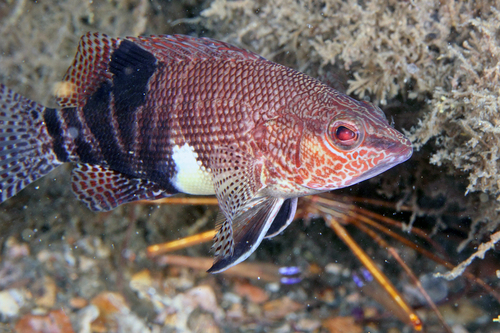
The belted sandfish, Serranus subligarius, has a laterally compressed, elongated body with a relatively short, pointed snout. Three clearly visible spines are present on its gill cover, and the middle spine is straight. The margins of its preopercle are serrated. Its dorsal fin has 10 spines and 12 to 14 soft rays, while its anal fin has 3 spines and 7 soft rays. The caudal fin is truncate. The head and body are reddish-brown, marked with lines formed by a dark spot on each body scale. A dark stripe runs through the eye and extends back to the anterior portion of the body. The posterior part of the body has 4 dark bars that extend onto the dorsal fin; the most forward of these bars is the most obvious, and it extends onto the anterior of the soft-rayed part of the dorsal fin as a clear black blotch. A distinct white bar is located in the middle of the lower body, immediately in front of the most forward dark bar. Wavy dark bars mark the dorsal, anal, and caudal fins, and some individuals have a pair of large black blotches at the base of the caudal fin. The pelvic fins are black with white leading edges. The maximum recorded total length of this species is 10 centimetres (3.9 in).
The belted sandfish occurs in the western Atlantic Ocean. Its range extends north to North Carolina, and continues south along the eastern coast of the United States into the Gulf of Mexico. In the Gulf of Mexico, its range runs from northwestern Cuba and the Florida Keys north and west along the Gulf coast to the United States-Mexico border, and along the coast of Mexico from Veracruz to Madagascar Reef on the Campeche Banks. It is also found in the Caribbean Sea along the southern coast of Cuba.
This fish inhabits silty waters with a mixed rubble and sand substrate, and is often found near jetties, rocky outcrops, and artificial reefs. It occurs from the water's edge down to a depth of 18 metres (59 ft). It is a predatory species: smaller individuals less than 40 millimetres (1.6 in) in total length eat small crustaceans including amphipods, gammarids, and shrimp. Larger individuals also eat amphipods, but additionally prey on crabs, other fishes, and shrimp. Belted sandfish are solitary, and hunt close to the substrate typically at sunset. They capture prey by creating powerful suction when opening their large mouth to draw prey in, then swallow it whole. The belted sandfish is a synchronous hermaphrodite, meaning each individual has both functional male and female gonads, so self-fertilization is at least theoretically possible. This species displays three distinct mating strategies: some individuals act as females, some are opportunistic streaker males, and courting males behave similarly to males of gonochoristic (separate sex) species. Individuals shorter than 7.5 centimetres (3.0 in) are most commonly female, while larger individuals breed more often as courting males. Opportunistic streaker males tend to be smaller, but can be any size.