About Serranus scriba (Linnaeus, 1758)
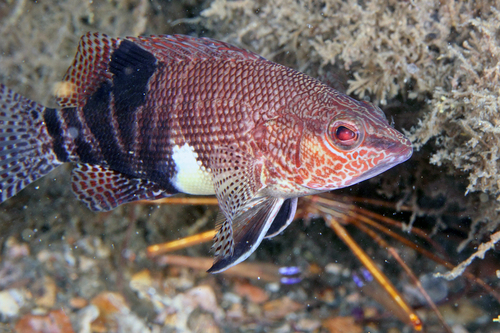
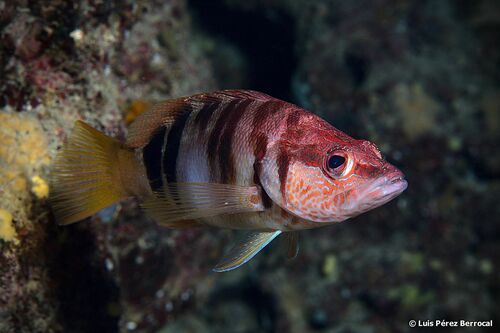
The painted comber, Serranus scriba, has an elongate, laterally compressed body with a pointed snout. Its dorsal fin has 10 spines and 4 to 16 soft rays, while its anal fin has 3 spines and 7 to 8 soft rays; the caudal fin is truncate. This species has a very large, protractile mouth for its size, lined with many sharp teeth. Its base body color can be grey, purplish, or reddish, with 5 to 7 dark brown bars running along its flanks. The head is patterned with many narrow, wavy blue lines and red blotches. The dorsal, anal, and caudal fins are marked with red dots, and a diffuse purplish-blue blotch sits in the middle of the body. The pelvic and pectoral fins are typically a uniform pale yellow. The maximum recorded total length for this fish is 36 centimetres (14 in), though a length of 25 centimetres (9.8 in) is more typical. The painted comber is distributed in the eastern Atlantic Ocean; its main range stretches from the Straits of Gibraltar to Senegal, including the Canary Islands, and it can be found as far north as the Bay of Biscay. Its range also extends into the Mediterranean and Black Seas, and Marmaris is one of the areas where this species is most abundant. The painted comber lives over rocky bottoms and within Posidonia seagrass beds, at depths between 5 and 150 metres (16 to 492 ft). During the day, it shelters in rocky caves, and it is usually solitary or found in small groups, emerging at dusk to hunt. It is a carnivorous, territorial ambush hunter that feeds on cephalopods, bivalves, crustaceans, fishes, and worms. This species is often a sign of octopus occupation at a site, as it waits at cave entrances to scavenge discarded shellfish parts left by octopuses. Its spawning season runs from late spring to early summer, and eggs are laid under stones near the shore. Painted combers are synchronous hermaphrodites: each individual has both male and female gonads, and may be capable of self-fertilisation. They can live up to a maximum of 16 years. Artisanal fisheries land painted comber using hook and line and trawls. The species has palatable flesh that can be cooked in a variety of ways.