About Serranus cabrilla (Linnaeus, 1758)
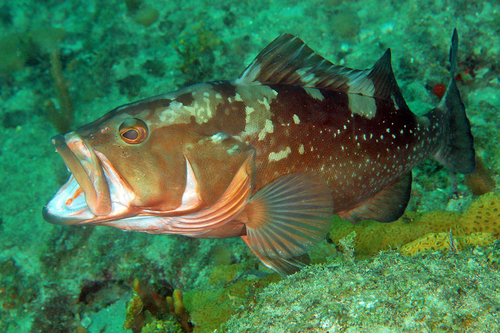
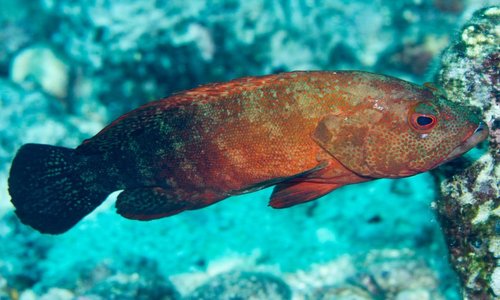
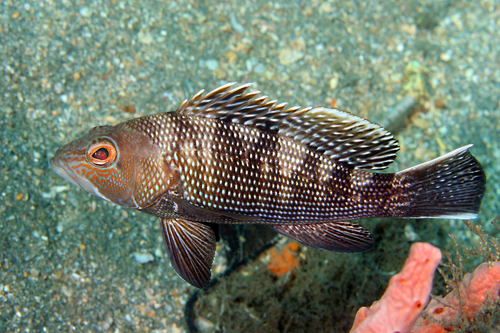
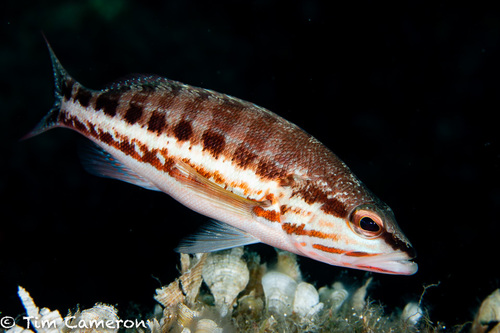
The comber, Serranus cabrilla, has a relatively stout body with a large head and prominent jaw. It has two connected dorsal fins: the first holds 11 thin spines, while the second has 13 to 15 branched rays. Its anal fin has 3 spines and 7 to 8 soft rays, and its caudal fin is slightly truncate in shape. Coloration ranges from light brown to dark brown to an intense reddish brown. 7 to 9 darker transverse bands run along its flanks, and these are intersected by a longitudinal white to yellowish stripe that extends from the head to the tail. A few yellow or orange longitudinal lines appear on the sides of its head. When the fish is in water, the first dorsal fin is normally folded flat against its back. Combers can reach a standard length of 40 centimetres (16 in), but individuals measuring 25 centimetres (9.8 in) are more common. This species has an extensive distribution in the eastern Atlantic. It occurs in the warmer waters of southern and southwestern England, off western Wales, south along the European coast to the Straits of Gibraltar, and continues into the Mediterranean and Black Seas. It also ranges along Africa’s west coast from Morocco south to Angola, and is found around the islands of Macaronesia and São Tomé and Príncipe in the Gulf of Guinea. Off the coast of South Africa, it occurs from the Cape of Good Hope to KwaZulu-Natal. While Red Sea records were originally thought to come from Anti-Lessepsian migration from the Mediterranean through the Suez Canal, genetic analysis has confirmed the Red Sea population existed before the Suez Canal opened. The comber lives on the continental shelf and upper continental slope, among rocks, Posidonia beds, and over sand and mud substrates. It can be found at depths up to 450 metres (1,480 ft). It is a predatory species that feeds mainly on crustaceans. Off the Canary Islands, diet changes with fish size: smaller fish eat more crabs, while larger fish feed on carideans. In other regions, its diet is recorded as very varied, including small and immature fish, annelids, and squid, and individuals have been observed scavenging on dead marine animals. The comber is a solitary, territorial species. It spawns between May and July, and is a hermaphrodite: mature individuals have both ovaries and testes. They can function as either male or female, and there are documented cases of self-fertilization when a fish cannot find a spawning partner. Fish reach sexual maturity when they grow to 152 millimetres (6.0 in) in length.