About Serranus baldwini (Evermann & Marsh, 1899)
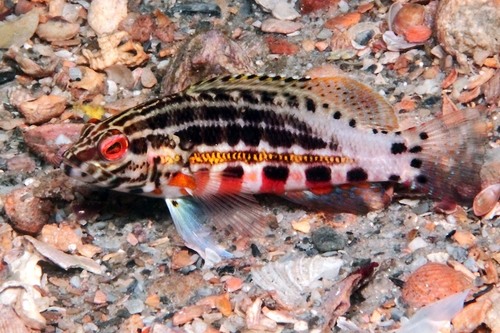
Serranus baldwini has a cylindrical, elongated body that is moderately laterally compressed. Its snout is shorter in length than the diameter of the eye. There are three well-developed spines on the gill cover; the middle spine is the largest and straightest. The edge of the preopercle is regularly serrated. The dorsal fin has 10 spines and 11 to 13 soft rays, while the anal fin has 3 spines and 7 soft rays. The caudal fin is slightly concave. The body is white, marked with lines of dark to orange oblong blotches and spots. A distinct row of dark, oblong blotches runs along the lower flank, and an additional row of four black spots is located on the caudal peduncle. Individuals from deeper water have red, orange, or yellower body hues, while fish from shallower water are paler. This species reaches a maximum total length of 12.0 centimetres (4.7 in).
Serranus baldwini occurs in the western Atlantic Ocean. Its range extends from Jacksonville, Florida southward along Florida's coast, around the Bahamas, and into the Gulf of Mexico, including the Florida Keys and areas further north. It is also found along Mexico's coast from Campeche, on the northern coast of the Yucatán Peninsula, from northwestern Cuba throughout the Caribbean, and along the coasts of Central America and South America as far south as São Paulo, Brazil.
This is a marine reef-associated species that inhabits rocky and weedy areas at depths between 1 and 80 metres. It has a strong association with turtle grass (Thalassia testudinum) beds, while juveniles hide inside empty conch shells. It is a territorial species that feeds on shrimps and smaller fishes. Serranus baldwini is synchronously hermaphroditic: when spawning, individuals can function as either male or female. The social structure of this species consists of a large territorial functionally male individual and a harem of hermaphrodites. The territorial male produces the most offspring by mating as a male with the hermaphrodites; while hermaphrodites can mate with one another, they do not produce as many offspring as the territorial male sires.