About Serpula vermicularis Linnaeus, 1767
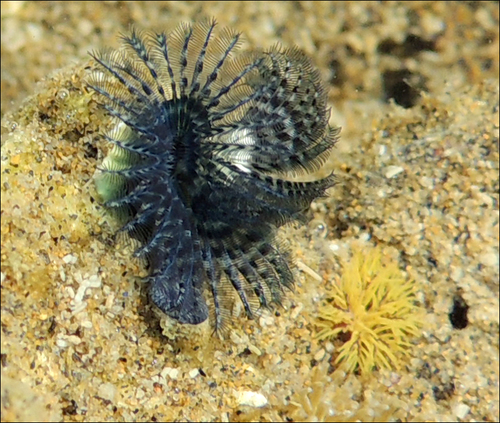
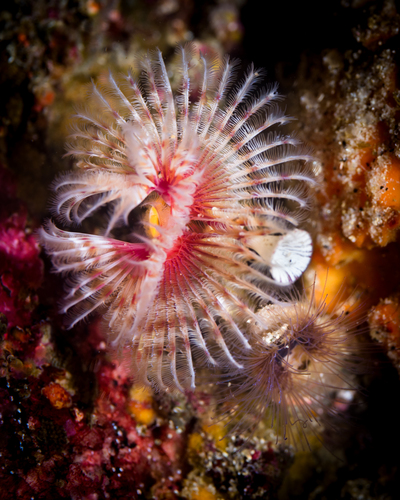
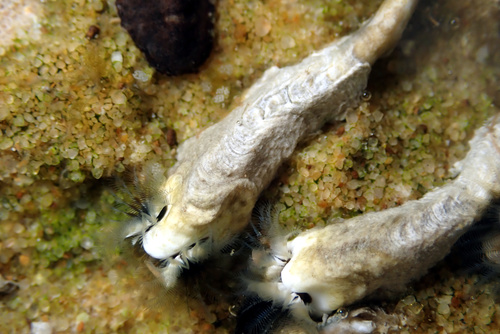
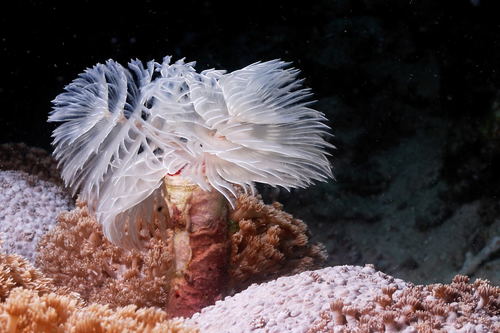
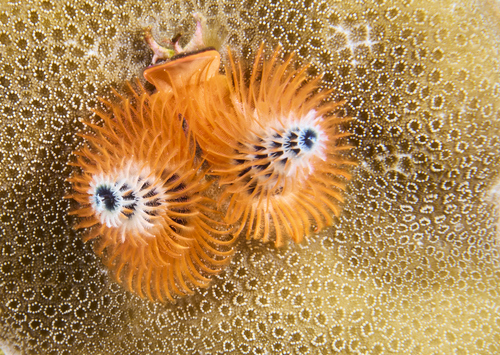
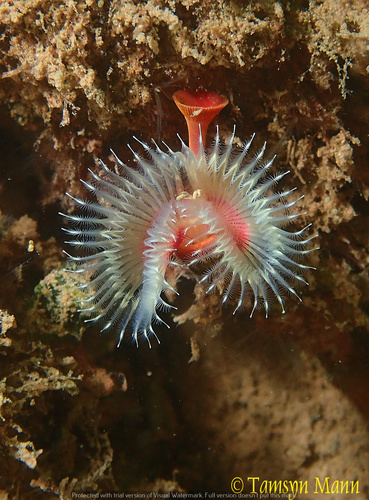
Serpula vermicularis Linnaeus, 1767 lives inside a calcareous tube that attaches to rocks, boulders, or other hard surfaces. The tube is often curved, but not tightly coiled like in some related species. It can reach a length of 20 cm (8 in), though most individuals are shorter. When extended, the anterior part of the worm protrudes from the tube, and has a plume of approximately 40 feather-like radioles that project from the second segment, called the peristomium. This segment also holds the worm’s two eyes and its mouth. The radioles are bipinnate and covered in fine cilia, are most commonly red, orange, or pink, and are typically banded with white. When the worm retracts into its tube, a symmetrical, funnel-shaped lid called an operculum closes off the entrance; this lid is usually red, has up to 160 fine creases around its edge, and is sometimes split in two. The worm’s yellow body has seven thoracic segments and up to 190 abdominal segments, all protected by the tube. The thoracic region contains at least four segments that bear setae, also called bristles. Serpula vermicularis has a cosmopolitan distribution. It can be found in the Pacific and Indian Oceans, along the European seaboard of the Atlantic Ocean, and along the Southern African coast from Olifant's River to Maputo, but it does not occur on the North American Atlantic coast. It inhabits the intertidal zone and can be found at depths down to 100 m (330 ft). This species grows on hard substrates, and favours bivalve shells, boulders, and man-made structures. Around the United Kingdom, abundant juveniles are often found growing on the bryozoan Flustra foliacea. Large colonies sometimes form, but these rarely develop on rocks. Serpula vermicularis larvae may settle on the tubes of other worms, and their continued growth can form reefs. These reefs are very fragile and often break apart, a process sometimes accelerated by the activity of boring sponges like Cliona celata, the red boring sponge. In the United Kingdom, spawning occurs between June and September. The larvae become part of the plankton for up to two months before settling on the seabed. Growth is relatively rapid: tubes can extend by 1 centimetre (3⁄8 in) per month. The worms reach maturity in around 10 months and may live for several years. Coldwater reefs formed by S. vermicularis take many years to develop, and provide a hard substrate that other organisms can colonize. Reefs around the United Kingdom support a diverse community of sessile invertebrates, including sponges, hydroids, ascidians, bryozoans, the worm Pomatoceros triqueter, the sea anemone Metridium senile, and multiple species of bivalves including Chlamys spp., Modiolus modiolus, and the queen scallop Aequipecten opercularis. Observed macrofauna on these reefs include the edible crab Cancer pagurus, the sea urchins Echinus esculentus and Psammechinus miliaris, the brittle star Ophiothrix fragilis, the starfish Asterias rubens, and the common whelk Buccinum undatum. In shallow water, red algae grow on the reef surface. The tunicate Pyura microcosmus is found on these reefs, and is rarely seen in other habitats. A large number of cryptic microfauna species take shelter among the worm tubes. Predators of Serpula vermicularis include sea urchins, starfish, and the wrasses Crenilabrus melops and Ctenolabrus rupestris.