About Serpula columbiana Johnson, 1901
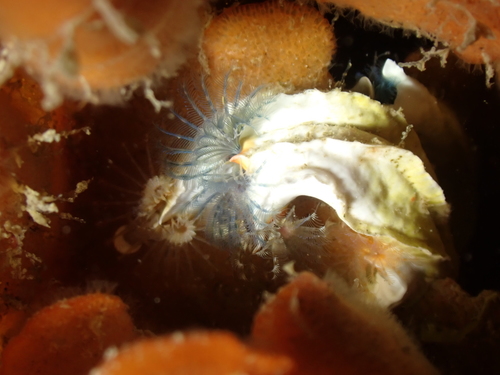
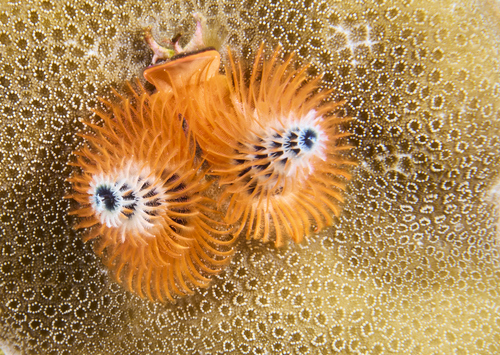
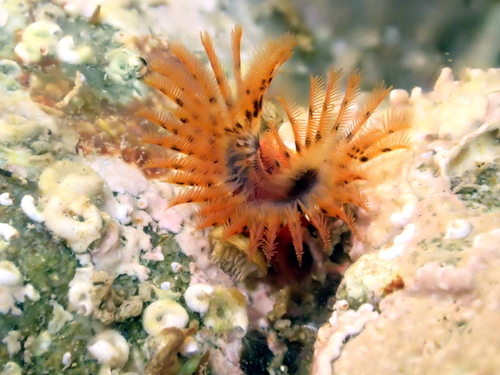
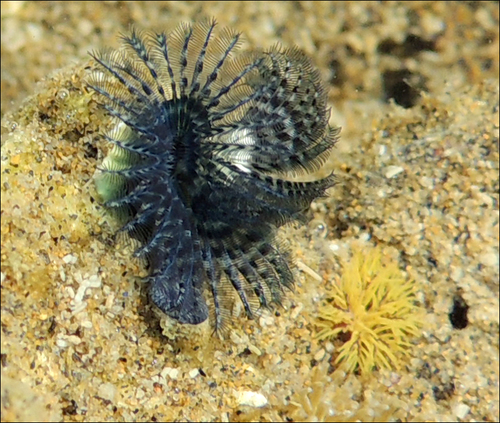
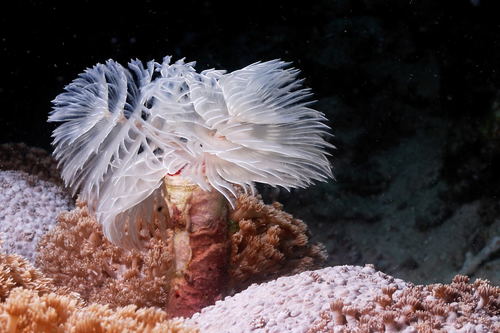
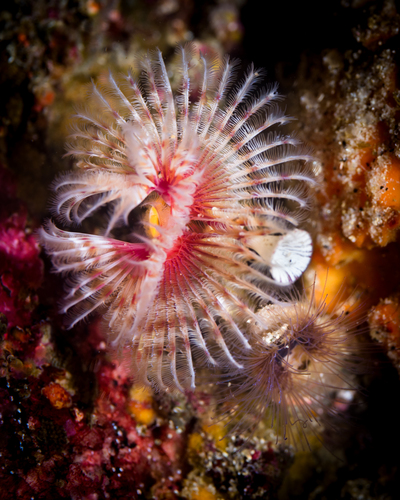
Serpula columbiana is a tube-dwelling annelid worm that constructs its own irregularly coiled, smooth calcareous tube, which attaches to the underlying substrate along most of its length. The tube's opening is protected by a funnel-shaped operculum that has approximately 160 tiny creases along its rim. Inside the tube, the worm's body is yellowish, and can grow up to 8 cm (3 in) long. It has around 40 featherlike radioles that form a crown, which the worm can extend out through the open end of the tube. The operculum is typically red, while the radioles are red, pink, or orange, and usually marked with white bands. The radioles attach to the peristomium, which bears a pair of eyes. This worm has seven thoracic segments and up to 190 abdominal segments.
Serpula columbiana has a widespread distribution across the Northern Hemisphere, and is found in the Indian Ocean, Pacific Ocean, Atlantic Ocean, North Sea, and Mediterranean Sea. In the Pacific Ocean, its range stretches from the Bering Strait to Japan, and from Alaska to Baja California. It inhabits hard substrates including rocks, wharves, pilings, and floats, and occurs from the intertidal zone down to depths of around 100 m (300 ft).
This species is a filter feeder that extends its radioles into the water to catch planktonic food particles. When threatened, the worm can quickly retract its radioles and close the operculum to seal the tube opening. The worm's heart pumps blood into the radioles, which also function as gills. Each radiole contains a single branchial vessel that receives blood; there is no continuous unidirectional circulation, and instead blood flows in and out alternately in a tidal pattern. Oxygen is carried in the blood by the pigment chlorocruorin, which has a specific affinity for carbon monoxide. It has been observed that the larvae of this worm sometimes settle and grow on brown seaweeds such as Fucus, but do not do so on Nereocystis. The proposed explanation for this pattern is that Nereocystis uses carbon monoxide to inflate its pneumatocyst (float chambers), which would likely make the seaweed toxic to Serpula columbiana.