About Serpophaga nigricans (Vieillot, 1817)
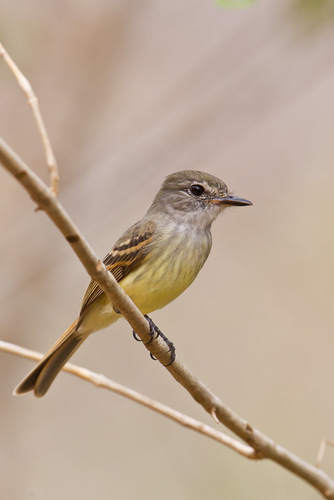
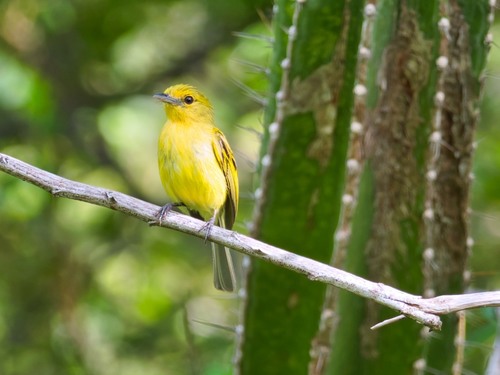
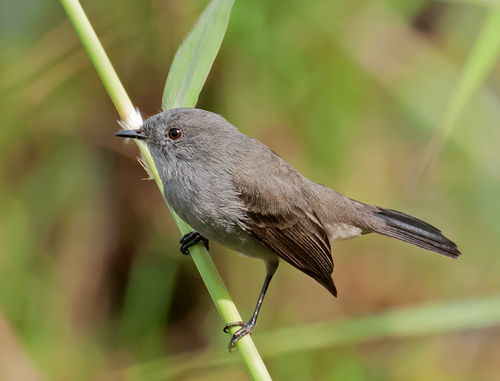
The sooty tyrannulet, Serpophaga nigricans, is overall dark grey, with a brownish tinge on its upperparts, paler underparts, and a slightly darker crown. It has a partially hidden white stripe on its crown, a whitish chin, two pale grey wingbars on its wings, and whitish inner flight feathers. Its tail is black, with brown irises, a black beak, and black legs. There is no visible difference between adult males and females, and juveniles of this species have not been formally described. The sooty tyrannulet has an average total length of 118–127 mm (4.6–5.0 in). Average measurements for other body parts are: tarsus length 16.8–20.3 mm (0.66–0.80 in), beak length 8.2–9.5 mm (0.32–0.37 in), and tail length 50.5–51.6 mm (1.99–2.03 in). The song of the sooty tyrannulet consists of a series of short notes followed by a sequence of higher, canary-like notes. It also produces a sharp "teek" call. Breeding pairs have been observed exchanging quiet trills and chatters with one another, and adults make a more complex vocalization when approached by a fledgling. The sooty tyrannulet is distributed across Tarija in southern Bolivia, Paraguay, southern Minas Gerais and Espírito Santo in southeastern Brazil, southern and central Argentina, and Uruguay. Since 2010, it has also been recorded in Tocantins, Brazil, where it had never been observed before. This species is largely non-migratory, though southernmost populations may migrate north after the breeding season ends. It typically occurs near streams, rivers, and water bodies associated with agricultural areas, and prefers brushy habitat near these water sources. It can sometimes also be found in forests located far from water, and occurs at elevations from sea level up to 1,000 m (3,300 ft). The sooty tyrannulet feeds on insects. While foraging, it makes constant small short flights between perches and almost never lands on the ground. It darts into midair to catch insects either in flight or from water surfaces, and often wags its tail while foraging. It breeds between October and December. Both males and females take part in nest building. Nests are usually constructed on a branch beneath an overhang, and may be built near human-made structures such as bridges. The nest is a cup made of densely packed roots and grasses, measuring 10 cm (3.9 in) deep and 4 cm (1.6 in) across, lined with feathers. The species lays an average of three eggs per clutch. It remains unknown how long egg incubation lasts, or how much time passes before hatchlings fledge. Shiny cowbirds have been observed to parasitize the nests of the sooty tyrannulet.