About Seriola rivoliana Valenciennes, 1833
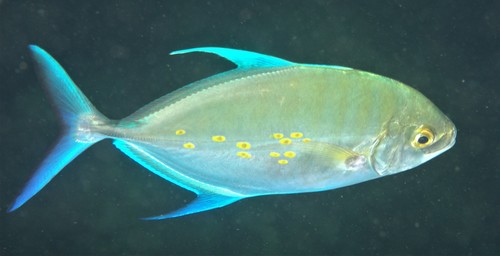
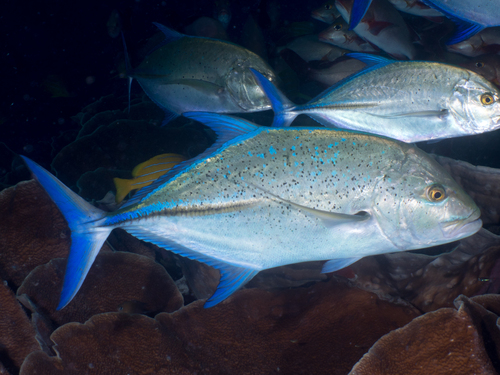
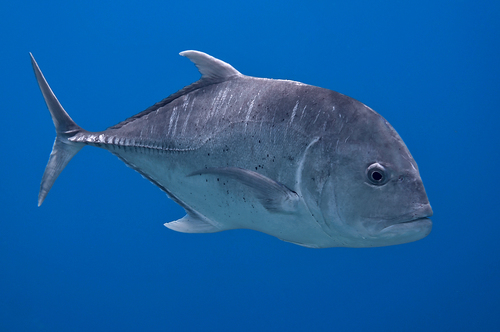
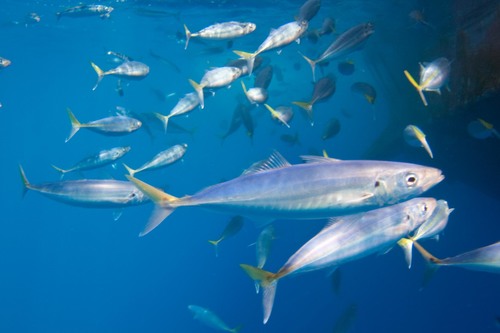
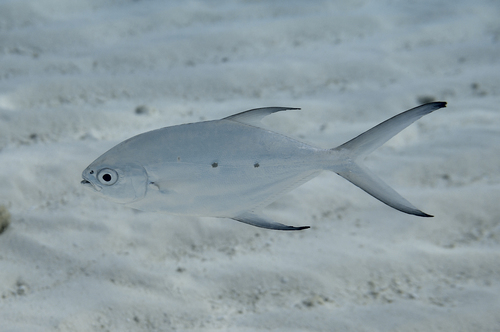
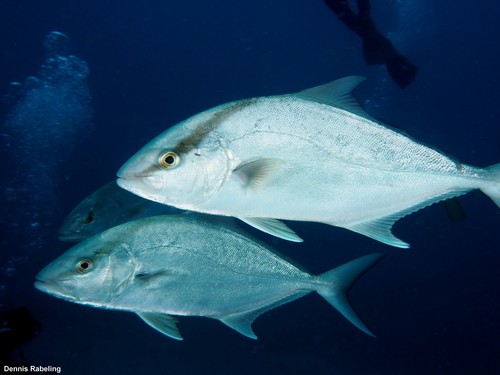
Longfin yellowtail (Seriola rivoliana Valenciennes, 1833), also called almaco jack, has a less elongated, more flattened body than most other jack species. Its dorsal and anal fins are elongated, with outer edges that have a distinct sickle shape. The longest first rays of its dorsal fin are nearly twice as long as the dorsal spines, which is another trait that sets it apart from other jacks. This species reaches a typical total length of 90 centimetres (35 in), and can grow to a maximum recorded length of 160 centimetres (63 in) and a maximum recorded weight of 59.9 kilograms (132 lb). According to the Florida Fish and Wildlife Conservation Commission, the typical weight of a caught longfin yellowtail is approximately 10 pounds. The commission also notes this species has a wide range, travels in small groups, and is not commonly caught. Most longfin yellowtails are dusky-colored, with faint amber or olive stripes running down their sides. Their upper bodies and lower fins are usually dark brown or dark blue-green. The belly is much lighter, with a brassy or lavender appearance. Adult individuals have a dark nuchal bar and most of their fins are dark; the only exception is the pelvic fins, which are white on their ventral sides. Longfin yellowtail is a pelagic species that lives in open-ocean zones of the deep waters beyond the continental shelf. It can be found in small groups on slopes and off reefs, at depths between 5 and 160 m, and it visits wrecks more often than most other jack species. It typically swims at depths ranging from 5–35 metres (16–115 ft). This species occurs from Kenya to South Africa across the Indian Ocean to the western Pacific Ocean, and has been recorded off the Mariana Islands, Wake Island, Ryukyu Islands, Kermadec Islands, and New Caledonia. In the eastern Pacific, it occurs from California to Peru, including the Galápagos Islands. In the western Atlantic, it occurs mostly from Cape Cod to northern Argentina, though it is rare off North and South Carolina. In the Northeast Atlantic, it is known from the Azores, Madeira, and mainland Portugal, and has also been reported in southern England and the Gulf of Biscay. It was first recorded in the Mediterranean Sea in 2000, near Italy’s Lampedusa Islands; more recent but sparse records exist from the Balearic Islands to the Gulf of Gabès. The flesh of the longfin yellowtail is quite delicious, and can be prepared in many different dishes, ranging from fully raw preparations such as sushi, sashimi, and crudo to fully cooked preparations such as grilled, steamed, and baked dishes.