About Seriola dumerili (Risso, 1810)
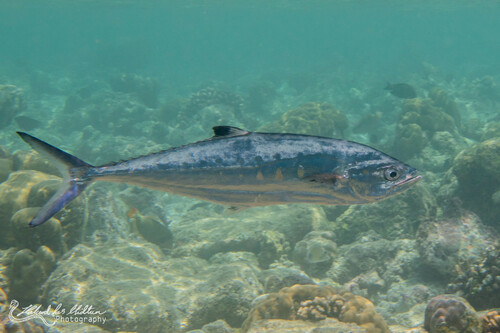
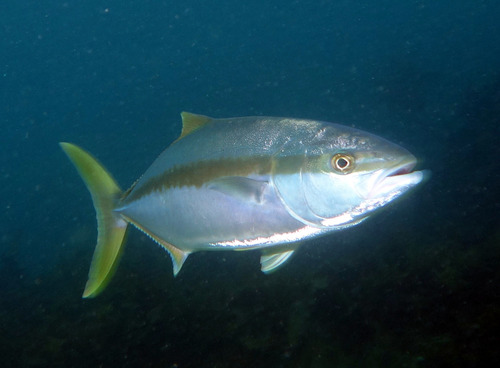
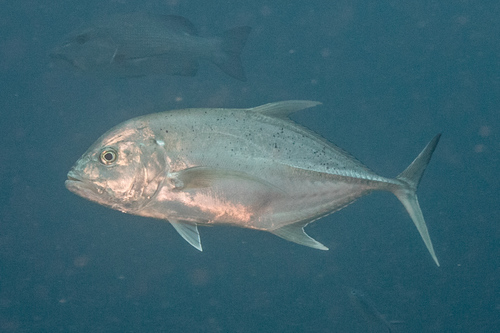
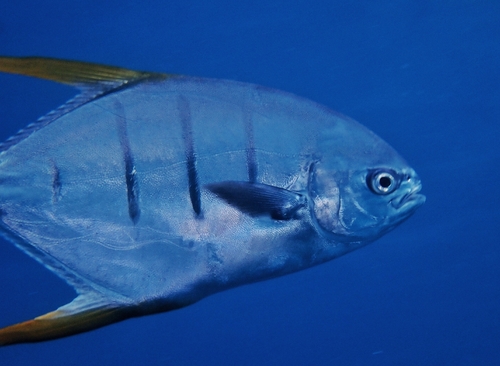
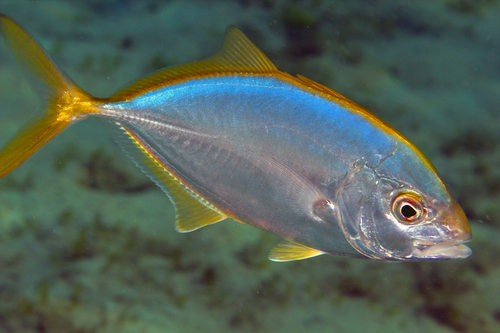
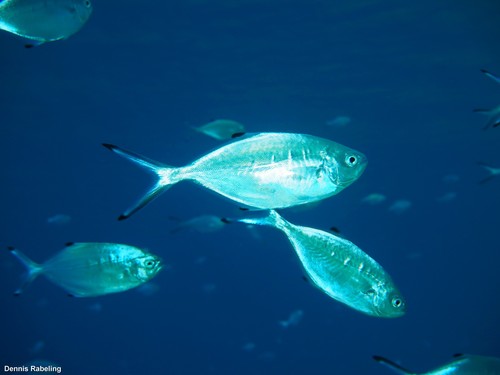
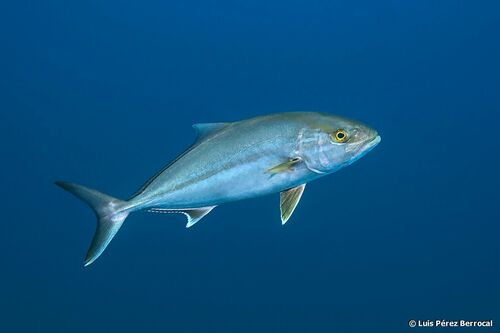
The greater amberjack (Seriola dumerili) is a large predatory fish. Its dorsal body color ranges from brownish to bluish-grey, contrasting with silvery-white underparts. A diagonal dark sooty stripe begins at the snout and runs along the center of the back dorsal fin; a second dark stripe extends from the upper jaw, across the eye, to the area in front of the first dorsal fin. Some individuals have a light yellow to reddish-brown stripe along their flanks, and all fins are dusky in color. The second dorsal and anal fins have a low anterior lobe. Small juvenile greater amberjack have clear fins, five vertical bands along their body, and a sixth vertical band on the caudal peduncle. The species has an elongated, fusiform body that is moderately deep, laterally compressed, and covered in small cycloid scales. The maximum recorded total length of the species is 190 cm (75 in), though a more typical total length is 100 cm (39 in). The heaviest published weight for a greater amberjack is 80.6 kg (178 lb). Greater amberjack have an almost circumglobal distribution in subtropical and tropical seas and oceans around the world. In the Indian Ocean, they occur along the African coast from South Africa eastward through the Persian Gulf to Western Australia. They range as far north as southern Japan, and reach the Hawaiian Islands and Micronesia in the Pacific Ocean, extending as far south as Tasmania off the Australian coast. In the western Atlantic Ocean, the species is found around Bermuda, along the North American coast from as far north as Nova Scotia south to Brazil, and includes the Gulf of Mexico and Caribbean Sea within its range. In the eastern Atlantic Ocean, greater amberjack have been recorded as vagrants as far north as the British Isles; they also occur in the Bay of Biscay, ranging south to Morocco and throughout the Mediterranean Sea. They may be present along the west African coast, but are easily confused with the closely related similar species Seriola carpenteri. Greater amberjack occur either as solitary individuals or in small to moderate-sized schools. They are epibenthic and pelagic, found near reefs, deep offshore caves, drop-offs, rocky outcrops, and deep seaward reefs. They sometimes enter coastal bays, and can also be found around shipwrecks. Juveniles are rarely found far out in the open ocean, where they shelter among floating algae such as Sargassum and floating debris. Smaller individuals, weighing less than 3 kg (6.6 lb), can be caught in shallow water, while larger fish prefer deeper water, typically between 18 and 72 m (59–236 ft); the species has been recorded at depths as great as 360 m (1,180 ft).