About Seringia hillii (F.Muell. ex Benth.) F.Muell.
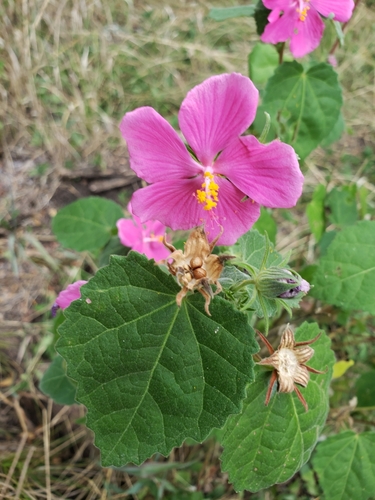
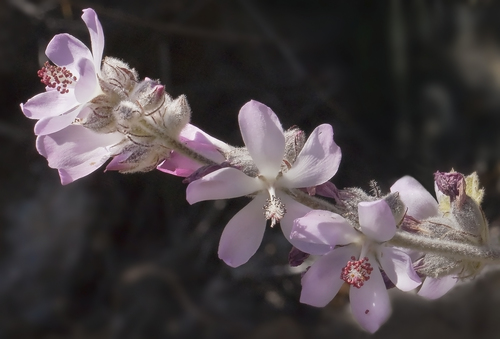
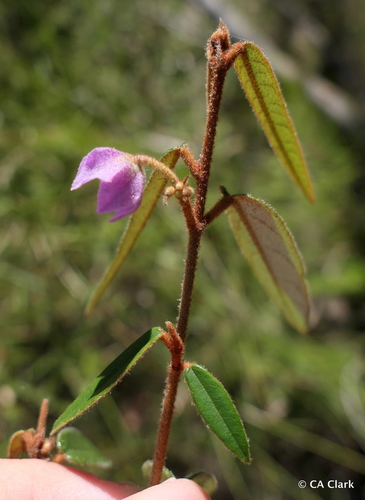
The scientific name referenced in this entry is Seringia hillii, though the description below details Seringia hermanniifolia. Seringia hermanniifolia is a single-stemmed shrub that typically reaches 1 to 3 metres (3 feet 3 inches to 9 feet 10 inches) in height and 1.0 to 1.5 metres (3 feet 3 inches to 4 feet 11 inches) in width. Its new growth is covered in rust-coloured hairs. The leaves are egg-shaped to linear or lance-shaped, 40 to 90 millimetres (1.6 to 3.5 inches) long and usually 4 to 8 millimetres (0.16 to 0.31 inches) wide, borne on a petiole up to 10 millimetres (0.39 inches) long. Narrow, leaf-like stipules 2 to 8 millimetres (0.079 to 0.315 inches) long grow at the leaf base. Flowers are arranged in cymes of 2 to 9 flowers, with the whole cyme reaching up to 20 millimetres (0.79 inches) wide. The cyme grows on a 5 to 15 millimetre (0.20 to 0.59 inch) long peduncle, and each individual flower sits on a 5 to 15 millimetre (0.20 to 0.59 inch) long pedicel. Flowers are mauve, sometimes white or pink, with deeply divided sepals. This species has no petals; stamens alternate with staminodes, and the yellow filaments are twice as long as the anthers. Flowering occurs across most months of the year, with a peak in spring and summer. The fruit is a spherical capsule 12 to 15 millimetres (0.47 to 0.59 inches) in diameter. Seringia hermanniifolia grows around cliffs and in rocky country near Stanthorpe, the Glasshouse Mountains and Mount Barney in south-east Queensland, and on the coast and ranges north from Port Stephens in New South Wales.