About Serilophus lunatus (Gould, 1834)
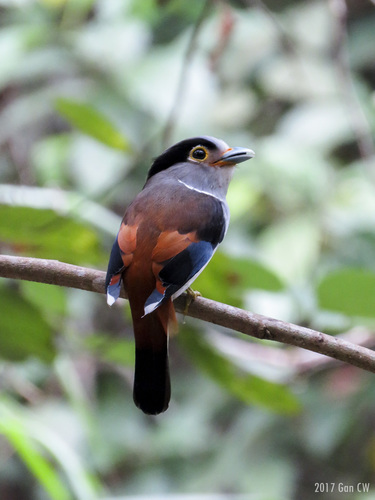
The silver-breasted broadbill, Serilophus lunatus, is a medium-sized broadbill that measures 16–17 centimetres (6.3–6.7 in) in length and weighs 25–35 grams (0.9–1.2 oz). For the nominate subspecies, the plumage features a rusty-coloured head with an ash-grey forehead and a broad black stripe (supercilium) over the eye. It has white breast and belly, bright rufous rump and upper wing coverts, striking blue and black flight feathers, and a black tail. There is small sexual dimorphism in plumage: females have a narrow silver band across the breast. Young birds look similar to adults but have shorter wings and tails, and slightly darker overall plumage. Plumage also varies slightly between different subspecies. This species is found in Cambodia, China, Indonesia, Laos, Malaysia, Myanmar, Nepal, Thailand, and Vietnam. Its natural habitats are subtropical or tropical moist lowland forest and subtropical or tropical moist montane forest, and it also occupies a range of other forest habitats including tropical and semi-tropical forests, semi-deciduous forests, and forests dominated by pine, oak, and bamboo. It can occur in selectively logged forests, and has even been observed in agricultural land and gardens. It occurs across a range of elevations: between 800–2,000 metres (2,600–6,600 ft) in Sumatra, and between 300–700 m (980–2,300 ft) in China. While the species has declined somewhat due to habitat loss, it is not considered threatened with extinction. The silver-breasted broadbill feeds on invertebrates, primarily insects such as grasshoppers, mantises, caterpillars, and larvae, as well as small land snails. It catches prey either by flycatching from a perch or by gleaning from branches and foliage.