About Sericornis frontalis (Vigors & Horsfield, 1827)
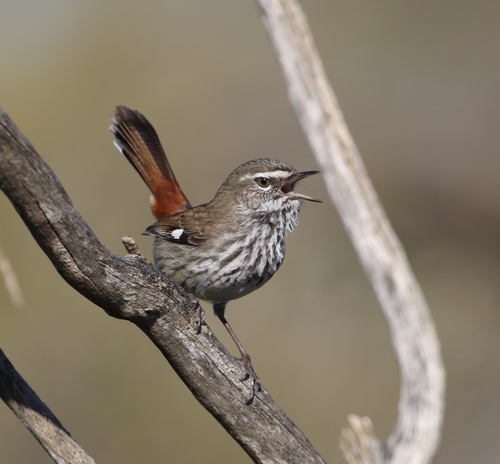
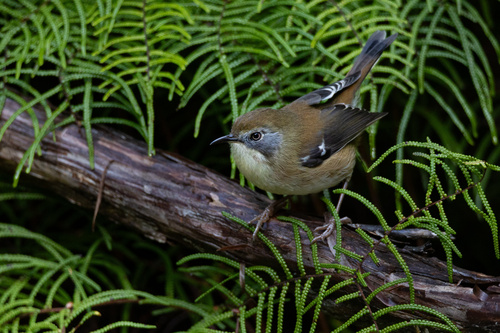
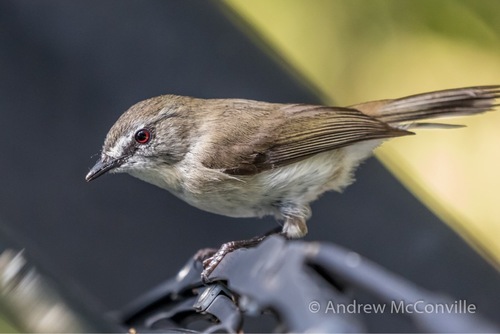
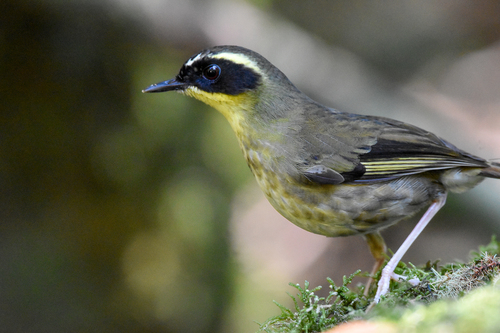
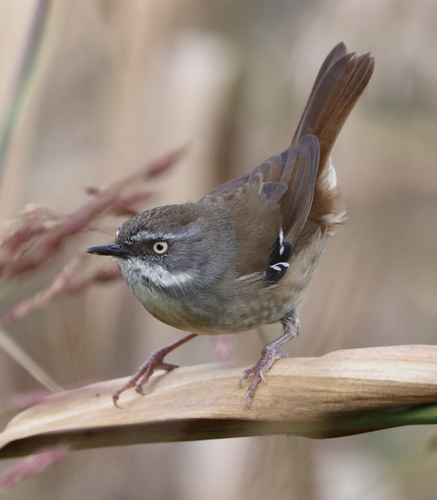
Sericornis frontalis is a small bird species. Mainland individuals measure 11.5 cm (4+1⁄2 in) in total length. They have olive-brown upperparts overall, though the spotted subspecies has greyish-brown upperparts and the Tasmanian population has dark brown upperparts. All members of this species have prominent pale irises and a white eyebrow stripe. The throat is white; it has faint streaks in the subspecies frontalis and laevigaster, and heavy dark spotting in the subspecies maculatus. Ear covert colour varies by subspecies: grey for frontalis, black for laevigaster, and brownish for the other two subspecies. Underparts are pale across the species, and buff-coloured specifically in laevigaster. The thin bill is black. Females are duller in colour overall than males, and typically have pale grey lores, while males have blackish lores. This plumage difference allows reliable sexing of most individuals in the field. The species' call is a loud, high-pitched ts-cheer or repeated ch-weip. This species favours forested or scrubby areas with abundant undergrowth, and it rarely leaves this vegetation type. It is a common bird in Sydney-surrounding bushland and on the New England Tablelands, and it is sedentary, staying in the same area year-round. Its breeding season runs from June or July through November or December. The nest is a dome-shaped structure built from dried grasses, leaves, sticks, bark and ferns, lined with feathers. Nests are placed on or near the ground within dense cover. Clutches contain two or three eggs that measure 20 x 15 mm; egg colour ranges from brownish-violet to brownish-white, with darker spots or blotches. The Tasmanian population of this species lays larger eggs that measure approximately 23 x 17 mm.