About Seriatopora hystrix Dana, 1846
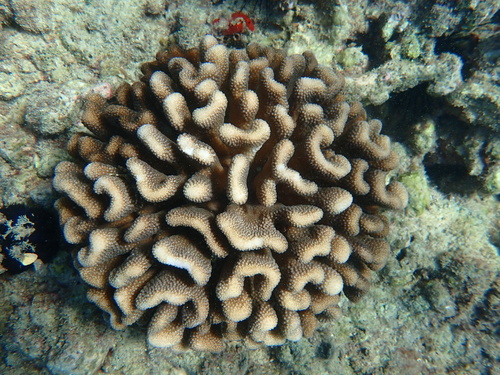
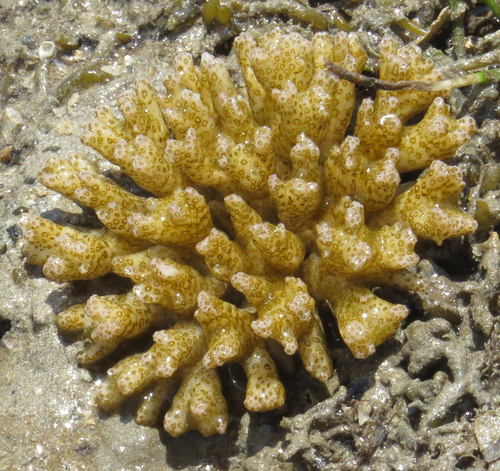
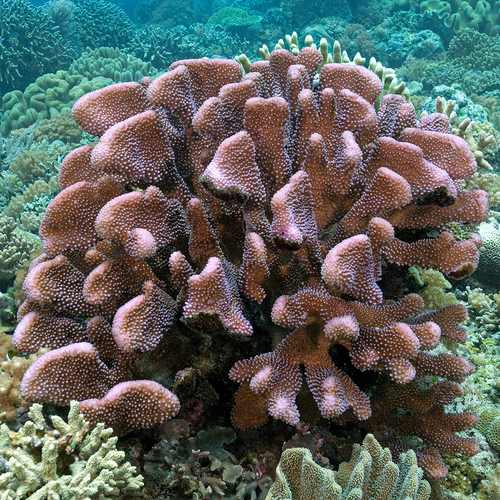
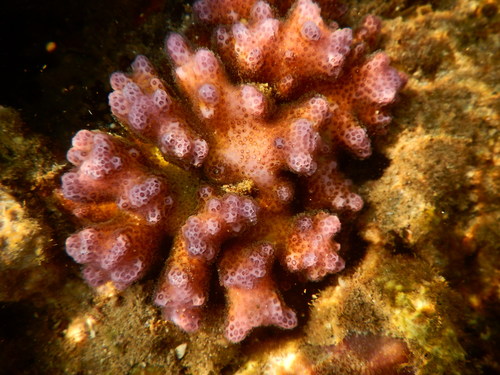
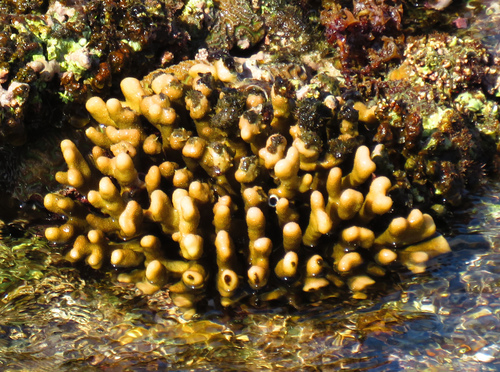
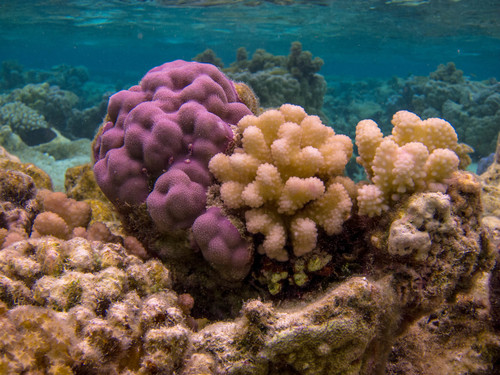
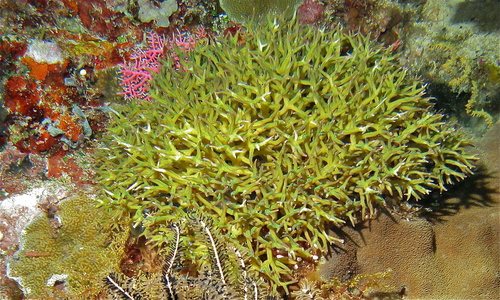
Colonies of Seriatopora hystrix form tangled, bushy clumps made up of fragile, slender, tapering branches that end in pointed tips. These clumps can grow up to one metre (one yard) across. In shallow locations with strong water movement, the coral’s branches are thicker than they are in deeper or turbid, sheltered habitats. The coral’s corallites form neat rows of oval cup-shaped depressions with raised rims; the coral’s polyps protrude from these depressions at night. This species can be cream, pink, yellow, brown, or blue in color. Seriatopora hystrix is native to the Indo-Pacific region. Its range extends from East Africa, Madagascar, and the Red Sea, through the Indian Ocean, to tropical Australia, Japan, the South China Sea, and the island groups of the West and Central Pacific. It grows on reefs and reef flats, mostly at depths between 3 and 15 m (10 and 49 ft). Seriatopora hystrix is a hermaphrodite: mature polyps produce both sperm and eggs. Sperm are released into the sea, then drawn into other polyps from the same or different colonies, and developing larvae are brooded maternally. Self-fertilisation may be an important reproductive strategy for this species. Once released, larvae typically settle within about 24 hours, which indicates a limited dispersal range. Most larvae settle within a few tens of metres of the parent colony, but others are likely carried by warm currents to more distant locations. S. hystrix is a zooxanthellate coral that hosts symbiotic dinoflagellates inside its tissues. These symbionts are transferred to larvae during brooding, and different Symbiodinium species associate with the coral in different parts of its range, which is considered a likely example of coevolution and specialization. This coral also reproduces asexually. Fragments broken off from branches can grow into new colonies if they are deposited in suitable locations. When the coral experiences stress, another form of asexual reproduction can occur that lets some polyps survive even if the parent colony dies. This process is called "polyp bail-out"; it involves the coenosarc (the living tissue covering the coral skeleton) growing to isolate a polyp, after which the polyp detaches, settles on the seabed, attaches, and grows a new skeleton. In laboratory settings, around 5% of these polyps survived to establish a new colony. This coral has a high growth rate, high reproductive output, and a short life span. It is a very successful species, and is often the first scleractinian coral to colonize a disturbed area. The tangled, bushy growth form of this coral provides a suitable habitat for other animals. Several species of symbiotic decapod crustaceans find shelter and protection here, and also get food from mucus the coral secretes. Two species of alpheid shrimp and three species of xanthid crab are thought to be obligate symbionts, meaning they are not found living anywhere else. The coral benefits from their presence, because the crustaceans may attack and stop predators from feeding on the coral. A single coral colony usually hosts only one species of symbiotic crustacean, including both adults and juveniles, but a large colony may host two species.