About Sequoia sempervirens (D.Don) Endl.
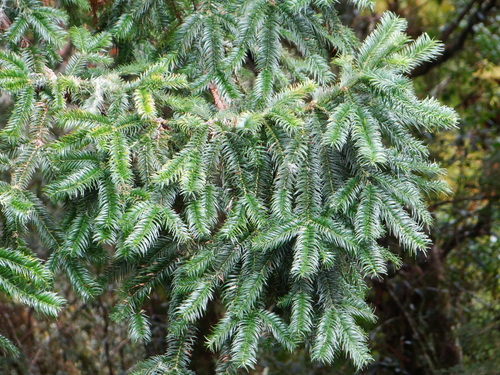
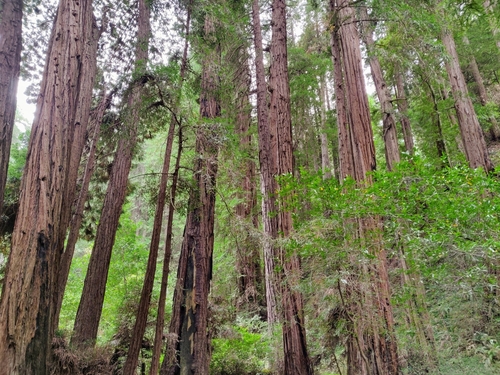
Sequoia sempervirens, commonly known as coast redwood, normally reaches 60 to 100 m (200 to 330 ft) in height, with some individuals exceeding 110 m (360 ft), and trunk diameters up to 9 m (30 ft). In 1893, American naturalist, physician, and founding member of the California Academy of Sciences William P. Gibbons (1812–1897) described a hollow coast redwood shell in the Oakland Hills of Alameda County that measured 9.9 metres (32 ft) in diameter at breast height. This tree's trunk girth is matched by the "Fieldbrook Stump" from Humboldt County, which has a diameter of 9.8 metres (32 ft) measured 1.5 metres (4.9 ft) from the ground. The Fieldbrook Stump remains intact today, with numerous healthy stump shoots growing around it. Coast redwoods have a conical crown with branches that grow horizontally or slightly droop downward, and their trunks are characteristically very straight. The bark can reach up to 35 cm (1.15 ft) in thickness, and is soft, fibrous, with a bright red-brown color when freshly exposed (the source of the common name "redwood"), darkening as it weathers. Coast redwoods have a root system made up of shallow, wide-spreading lateral roots. Their leaves vary in form: on young trees and shaded lower branches of older trees, leaves are flat and 15–25 mm (5⁄8–1 in) long, while on sun-exposed shoots in the upper crown of older trees, leaves are scale-like and 5–10 mm (1⁄4–3⁄8 in) long, with full transitional forms between the two extremes. Leaves are dark green on the upper surface and have two blue-white stomatal bands on the lower surface. Leaf arrangement is spiral, but larger shade leaves are twisted at the base to lie flat to capture maximum light. The species is monoecious, meaning it produces both pollen and seed cones on the same individual. Seed cones are ovoid, 15–32 mm (9⁄16–1+1⁄4 in) long, with 15–25 spirally arranged scales. Pollination occurs in late winter, with cones maturing 8–9 months later. Each cone scale holds 3 to 7 seeds; individual seeds are 3–4 mm (1⁄8–3⁄16 in) long and 0.5 mm (1⁄32 in) broad, with two 1 mm (1⁄16 in) wide wings. Seeds are released when cone scales dry out and open at maturity. Pollen cones are ovular, 4–6 mm (3⁄16–1⁄4 in) long. Native coast redwoods grow in a narrow strip along the Pacific coast of North America, approximately 750 km (470 mi) long and 8–75 km (5–47 mi) wide. The southernmost native grove is in Monterey County, California, and the northernmost native groves are in extreme southwestern Oregon. The species was introduced to multiple sites in Victoria, Australia for experimental purposes in the 1930s, and has since thrived there. In its native range, coast redwoods most commonly grow at elevations between 30–750 m (100–2,460 ft) above sea level, and occasionally occur from sea level up to about 900 m (3,000 ft). They typically grow in mountain areas where precipitation from incoming ocean moisture is higher. The tallest and oldest coast redwoods are found in deep valleys and gullies with year-round flowing streams and regular fog drip; this terrain also historically made access and extraction by loggers more difficult. Above the fog layer, roughly 700 m (2,300 ft) elevation, trees are shorter and smaller due to drier, windier, colder conditions, and are often outcompeted by Douglas-fir, pine, and tanoak. Few coast redwoods grow close to the ocean, due to intense salt spray, sand, and wind. Fog that condenses on the trees meets a considerable portion of the species' water needs, but fog cover in the 21st century is reduced compared to the prior century, an issue that may be worsened by climate change. The northern boundary of the current native range is marked by two groves on mountain slopes along the north side of the Chetco River, on the western edge of the Klamath Mountains near the California-Oregon border; the northernmost grove lies within Alfred A. Loeb State Park and Siskiyou National Forest at approximately 42°07'36"N 124°12'17"W. The southern boundary of the current native range is the Silver Peak Wilderness of Los Padres National Forest in the Santa Lucia Mountains of the Big Sur area of Monterey County, California; the southernmost grove is in the Southern Redwood Botanical Area, just north of the national forest's Salmon Creek trailhead and near the San Luis Obispo County line. The largest and tallest populations are in California's Redwood National and State Parks (Del Norte and Humboldt counties) and Humboldt Redwoods State Park, with the majority of all native coast redwoods located in Humboldt County. The ancient range of the Sequoia genus was far larger than today, with coast redwood relatives growing across Europe and Asia before the Quaternary geologic period. Coast redwood has also shifted its range considerably in North America during recent geologic time. Coast redwood bark found in the La Brea Tar Pits shows that 25,000–40,000 years ago, during the last ice age, coast redwoods grew as far south as the Los Angeles area. A 2022 research paper notes that, "Were it not for the remarkable ability to sprout after fire, many southern forests may have lost their Sequoia component long ago." To the north of the current range, an upright fossil coast redwood stump on a beach in central Oregon has been documented 257 km (160 mi) north of the species' current northern limit. Coast redwood can reproduce both sexually by seed and asexually by sprouting buds, layering, or lignotubers. Seed production begins when trees are 10–15 years old. Cones develop over winter and mature by fall. In their early growth stage, cones resemble flowers, and are often called "flowers" by professional foresters, though this is not botanically correct. Coast redwoods produce many cones, with trees in young new forests producing thousands of cones per year. A single cone holds 90–150 seeds, but seed viability is low, typically well below 15%, with average estimates ranging from 3 to 10 percent. Viability increases with tree age: trees under 20 years old have an average seed viability of about 1%, and viability generally does not reach its highest levels until trees reach 250 years old. Viability then decreases as trees become very old, with trees over 1,200 years old having no more than 3% seed viability. Low seed viability may discourage seed predators, which avoid wasting time sorting empty seeds from edible ones. Successful germination often requires a fire or flood event to reduce competition for seedlings. The winged seeds are small and light, weighing 3.3–5.0 mg (200–300 seeds per gram; 5,600–8,500 per ounce). Their wings are not effective for long-distance dispersal, so wind dispersal carries seeds an average of only 60–120 m (200–390 ft) from the parent tree. Seedlings are vulnerable to fungal infection and predation by banana slugs, brush rabbits, and nematodes, and most seedlings do not survive their first three years. However, established seedlings grow very quickly, with young trees recorded reaching 20 m (66 ft) tall in 20 years. When there is no available canopy space, small young trees can remain growth-suppressed for up to 400 years before accelerating their growth rate. Coast redwood can also reproduce asexually through layering or sprouting from the root crown, stump, or even fallen branches. If a tree falls over, it will produce a row of new trees along its trunk, resulting in many trees naturally growing in straight lines. Sprouts grow from dormant or adventitious buds at or under the bark surface; dormant sprouts are triggered to grow when the main adult stem is damaged or begins to die. Many sprouts spontaneously grow and develop around the circumference of a tree trunk. Each sprout develops its own root system shortly after sprouting, and dominant sprouts form a ring of trees around the parent root crown or stump called a "fairy ring". Sprouts can reach 2.3 m (7 ft 7 in) in height in a single growing season. Coast redwoods can also reproduce from burls, which are woody lignotubers that most commonly form on redwood trees below the soil line, usually within 3 m (10 ft) of the soil surface. Coast redwoods develop burls as seedlings from the axils of their cotyledons, a trait that is extremely rare among conifers. When triggered by damage, dormant buds in burls sprout to produce new shoots and roots. Burls can also sprout into entirely new trees when detached from the parent tree, though the exact mechanism of this process has not yet been studied. Shoot clones sprouted from burls are often shaped into decorative hedges in suburban landscapes. Coast redwood is one of the most valuable timber species in the lumber industry. In California, 3,640 km2 (899,000 acres) of redwood forest have been logged, almost all of which is now second-growth forest. The Pacific Lumber Company (1863–2008) of Humboldt County, California, which owned and managed over 810 km2 (200,000 acres) of primarily redwood forest, has had one of the most prominent roles in redwood logging and management. Coast redwood lumber is highly valued for its beauty, light weight, and resistance to decay. Its low resin content allows it to absorb water and resist fire. P. H. Shaughnessy, Chief Engineer of the San Francisco Fire Department, wrote after the 1906 San Francisco earthquake and fire: "In the recent great fire of San Francisco, that began April 18th, 1906, we succeeded in finally stopping it in nearly all directions where the unburned buildings were almost entirely of frame construction, and if the exterior finish of these buildings had not been of redwood lumber, I am satisfied that the area of the burned district would have been greatly extended." Because of its excellent decay resistance, redwood was widely used to make railroad ties and trestles across California. Many old redwood ties have since been recycled for garden use as edging, steps, and house beams. Redwood burls are used to make table tops, veneers, and turned craft goods. Before European settlement, the Yurok people, the original inhabitants of the region, regularly burned ground cover in redwood forests to expand tanoak populations (from which they harvested acorns), maintain forest clearings, and support populations of useful plant species used for medicine or basketmaking. Large-scale logging of coast redwoods began in the early 19th century. Trees were felled by ax and saw onto beds of tree limbs and shrubs to cushion their fall. After being stripped of bark, logs were transported to mills or waterways by oxen or horses. Loggers then burned accumulated branches, shrubs, and bark. Repeated fires favored the growth of secondary forests dominated by redwood, as redwood seedlings sprout readily in burned areas. The introduction of steam engines allowed logging crews to drag logs along long skid trails to nearby railroads, extending logging access beyond areas near rivers that were previously used to transport logs. However, this harvesting method disturbed large amounts of soil, leading to secondary-growth forests dominated by species other than redwood, such as Douglas-fir, grand fir, and western hemlock. After World War II, trucks and tractors gradually replaced steam engines, leading to two main harvesting approaches: clearcutting and selection harvesting. Clearcutting involves felling all trees in a given area; this approach was encouraged by tax laws that exempted all standing timber from taxation if 70% of trees in the area were harvested. By contrast, selection logging calls for removing 25% to 50% of mature trees, with the expectation that remaining trees would support future growth and reseeding. However, this approach favors growth of other tree species, converting pure redwood forests into mixed forests of redwood, grand fir, Sitka spruce, and western hemlock. Additionally, the remaining mature trees left standing are often blown over by wind in a process called windthrow. Coast redwood is naturalized in New Zealand, most notably at Whakarewarewa Forest, Rotorua. Redwood has been grown in New Zealand plantations for over 100 years, and trees grown in New Zealand have faster growth rates than those in California, primarily due to even rainfall distribution throughout the year. Other areas outside the native range where coast redwood is successfully cultivated include Great Britain, Italy, France, Haida Gwaii, middle elevations of Hawaii, Hogsback in South Africa, the Knysna Afromontane forests in the Western Cape, Grootvadersbosch Forest Reserve near Swellendam, South Africa, the Tokai Arboretum on the slopes of Table Mountain above Cape Town, a small area in central Mexico (Jilotepec), and the southeastern United States from eastern Texas to Maryland. It also grows well in the Pacific Northwest (Oregon, Washington, and British Columbia), far north of its northernmost native range in southwestern Oregon. Coast redwood trees used in a display at Rockefeller Center were later donated to the Longhouse Reserve in East Hampton, Long Island, New York, where they have survived for over twenty years including temperatures as low as 2 °F (−17 °C). This fast-growing species can be grown as an ornamental specimen tree in large parks and gardens that can accommodate its massive size, and it has received the Royal Horticultural Society's Award of Garden Merit.