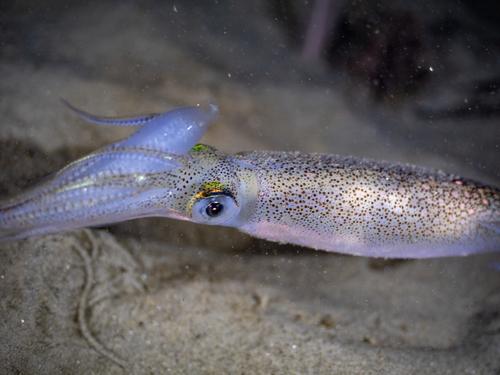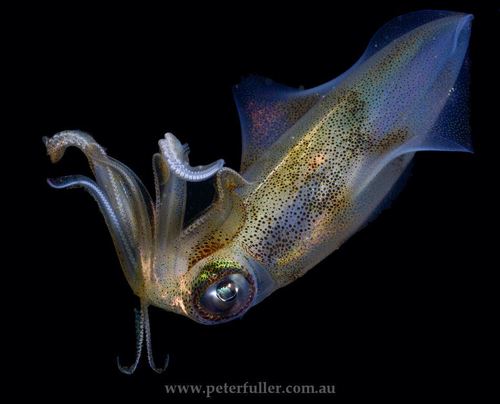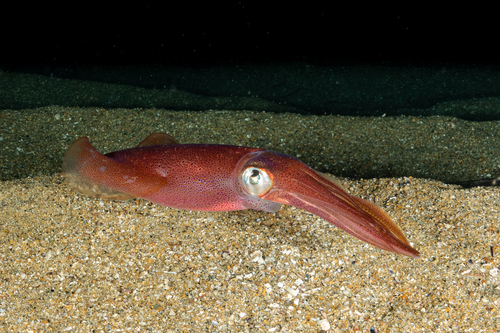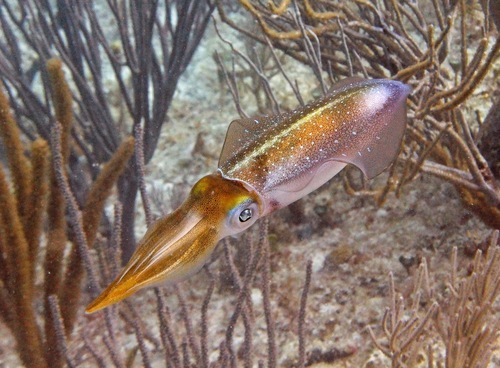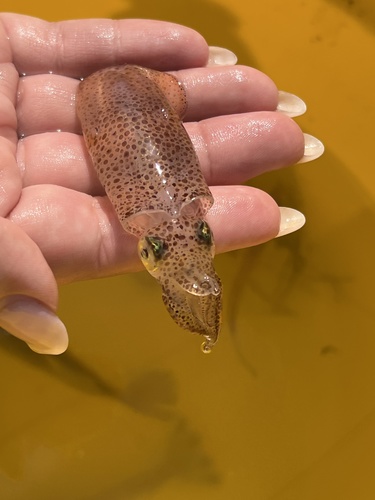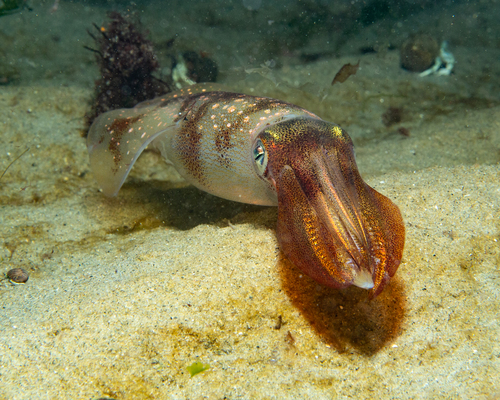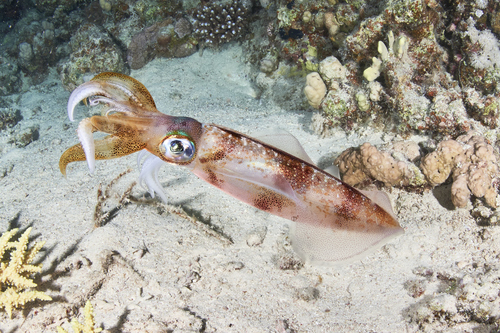
About Sepioteuthis lessoniana d'Orbigny, 1826
Like other members of the genus Sepioteuthis, bigfin reef squids (Sepioteuthis lessoniana) can be easily distinguished from other squids by their thick, muscular oval fins, which extend around almost the entire mantle. Their fins reach 83 to 97% of the mantle length, and measure 67 to 70% of the mantle length in width. Because of these large fins, bigfin reef squids are sometimes mistaken for cuttlefish, which is reflected in their scientific name. A narrow blue or white line is visible where the fins attach to the mantle, and a fleshy ridge forms where the two fins meet at the back of the squid. Bigfin reef squids have cylindrical mantles that taper to a blunt cone at the posterior end. Mantle length is typically 4 to 33 cm (1.6 to 13.0 in) in males, and 3.8 to 25.6 cm (1.5 to 10.1 in) in females; both sexes can reach a maximum mantle length of 38 cm (15 in). Adult males weigh 403.5 to 1,415 g (0.890 to 3.120 lb), while adult females weigh 165 to 1,046 g (0.364 to 2.306 lb), and both sexes can reach a maximum documented weight of 1.8 kg (4.0 lb). The forward ventral margin of the mantle is concave. Their eyes are large, completely covered by a transparent secondary cornea, and greenish at the base. A pair of prominent olfactory crests sits on the ventral surface of the head, at the rear edge of the eyes. The mouth region is supported by seven triangular buccal lappets, each holding 0 to 7 suckers smaller than 0.2 mm in diameter, plus 18 to 25 teeth. The squid’s strong, short, curved beaks (rostra) are mostly black to dark brown. Its radula has seven rows of teeth. Male spermatophores are about 4.5 mm (0.18 in) long and 0.15 mm wide. The ink sac is pear-shaped, with a silvery blue-green outer layer. The vane of the gladius, the rigid internal remnant of the mollusc shell, is oval-shaped and pointed at both ends (lanceolate), with a broad central midrib (rachis). The squid has eight thick arms that taper to a narrow point, and they are unequal in length: arm pair I is the shortest, followed by arm pair II, then arm pair IV, with arm pair III the longest. All arms have two rows of suckers. Each sucker has a diameter less than 2 mm (0.08 in) that decreases toward the arm tip, and a ring of 17 to 28 sharp acute teeth. In males, the left arm of pair IV is modified into a sexual organ called the hectocotylus, which bears long fleshy protrusions (papillae) with toothless suckers at its distal end. The tentacles are thick and long, reaching the full length of the mantle when retracted, and are slightly compressed side-to-side. Each tentacle club, the wide tip of the tentacle, has a prominent keel ridge on its outer surface. There are four rows of suckers on both the manus (the proximal part of the club) and the dactylus (the distal part of the club). The larger suckers in the center of the manus have 17 to 18 widely spaced teeth. Bigfin reef squid is a neritic warm-water squid, usually found 0 to 100 m (0 to 328 ft) below the water surface. It tends to stay close to shorelines, near rocks and reefs. It is slightly more active at night, and moves to deeper water or seeks cover during the day. Large groups of juveniles are often found hiding beneath floating driftwood. It is the most widespread species in the genus Sepioteuthis, found in temperate and tropical regions of the Indian Ocean and western Pacific Ocean. Its native range extends east to the Hawaiian Islands, west to the Red Sea, north to Japan, and south to Australia and New Zealand, between 42°N to 42°S and 32°E to 154°W. Its range has expanded to include parts of the Mediterranean Sea. Bigfin reef squids were first documented in the Gulf of İskenderun, in the southeastern Mediterranean Sea, in 2002. They may have already had significant populations in the area before this 2002 discovery, as they have a common name among Aegean Sea fishermen: σουπιοκαλάμαρο (soupiocalamaro, literally "cuttlefish-like squid"). It is a Lessepsian migrant that reached the Mediterranean Sea through the Suez Canal. The main spawning season for bigfin reef squids usually begins in May, but they lay eggs year-round, and spawning seasons can vary by location. A single female can spawn more than once in her lifetime. Females release 20 to 1180 eggs total per individual, and die soon after spawning. When spawning, females pass eggs out through their oviducts. The eggs are then coated in gelatinous secretions from the nidamental and oviducal glands, forming an egg capsule. Each bigfin reef squid egg capsule holds two to nine eggs. Females lay these capsules in single straight strands attached to rocks, corals, aquatic plants, submerged branches, and other surfaces. When laid, the eggs are 3 mm (0.12 in) in diameter, and the egg capsules average about 58.2 mm (2.29 in) long and 12.6 mm (0.50 in) wide. Capsules incubate for around three weeks, though incubation time depends on water temperature. In warmer Indonesia, incubation was recorded at only 15 to 16 days, while in Thailand it takes around 20 to 22 days. As they incubate, capsules gradually absorb water and enlarge, reaching around 82.4 mm (3.24 mm) in length and 14.6 mm (0.57 in) in width. Unfertilized eggs stay milky white and do not develop further. Fertilized eggs undergo cell division, reaching 16 mm (0.63 in) in diameter with an 11 mm (0.43 in) developing embryo the day before hatching. When they hatch, paralarvae have a mantle length of 6 mm (0.24 in, excluding tentacles), with fully functional fins and ink sacs. They resemble miniature adults and are already strong swimmers, and develop schooling behavior two weeks after hatching. Hatchlings are often cannibalistic, which is considered the main cause of death for young squids, especially in dense populations. However, cannibalism usually only targets individuals that are already significantly weakened or dead, so the actual original cause of death may be different. Subadults are typically identifiable by their size, ranging from 20 to 60 mm (0.79 to 2.36 in) in mantle length. Bigfin reef squids reach sexual maturity in less than 210 days in the wild, with males maturing earlier than females. In captive populations, males mature at most 140 days after hatching. Females begin spawning around 156 to 196 days after hatching. Both sexes mature earlier in captivity than in the wild. Water temperature may play an important role in the earlier sexual maturation of captive individuals: high temperatures may lead to shorter lifespans and smaller body sizes, while cooler temperatures support longer lifespans and larger individuals. Bigfin reef squids have one of the fastest recorded growth rates of any large marine invertebrate, and can reach 600 g (1.3 lb) in just four months. Even so, size cannot often be reliably correlated with age, as body size variation within a single generation is fairly common. In captivity, both sexes of bigfin reef squid have a lifespan of 161 to 315 days.