About Sepioteuthis australis Quoy & Gaimard, 1832
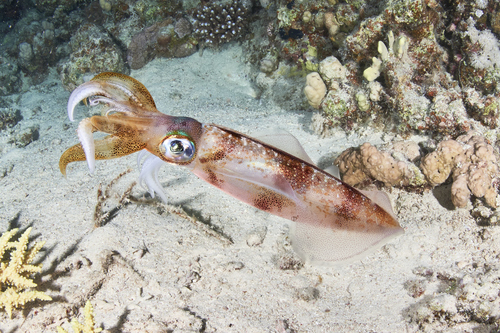
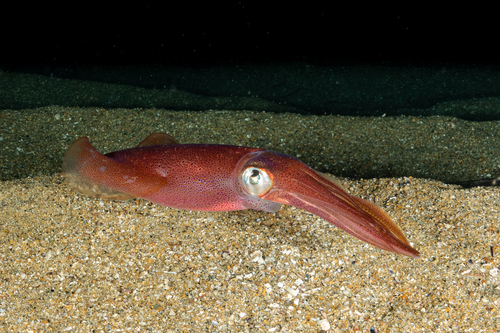
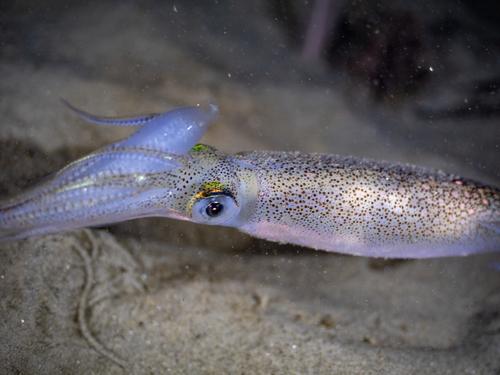
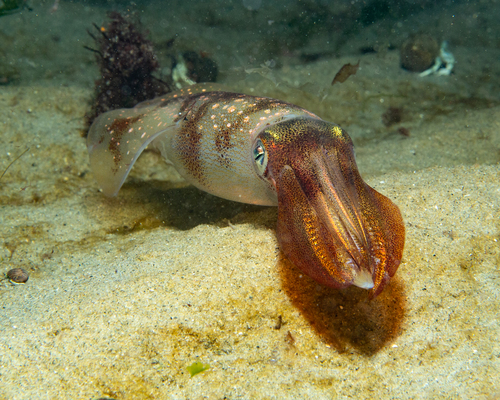
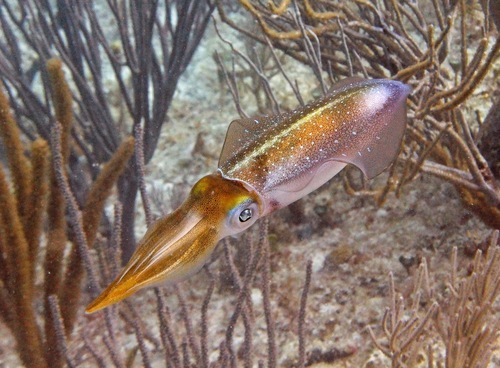
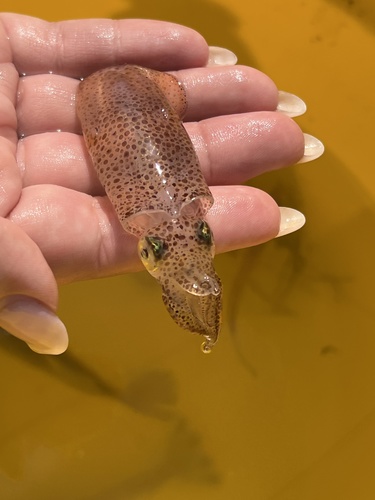
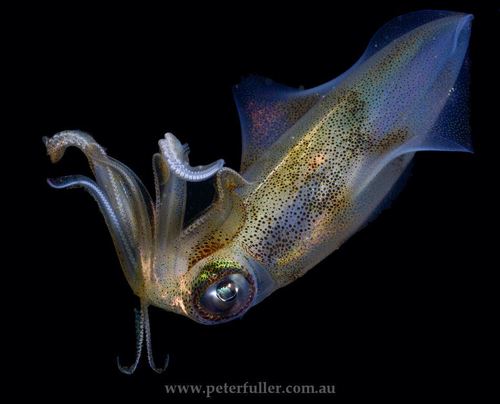
This squid, Sepioteuthis australis Quoy & Gaimard, 1832, reaches a maximum total length of around 38 cm (15 in) and a maximum weight of about 1 kg (2.2 lb). Its mantle is robust, tapering bluntly to a point. The eight arms have three rings of suckers with up to thirty hooks total, while the two tentacles have long clubs that hold moderate-sized suckers with additional hooks positioned around the suckers. Its diamond-shaped fins stretch almost the entire length of the mantle, are widest at their midpoint, and have a width more than half their length. When alive, this squid is semi-transparent, but it quickly changes to a uniform orangish-brown or rust colour after being caught and removed from the water. A white or bluish luminescent streak runs along the base of each fin. This species, commonly called the southern reef squid, is native to the subtropical Indo-Pacific, occurring between 16°S and 42°S latitude, and between 112°E and 179°E longitude. It is a benthopelagic species that lives at depths from 0 to 10 m (0 to 33 ft). Its range covers southern Australia, extending from Western Australia’s Ningaloo Coast along the southern coast to Tasmania and the Great Barrier Reef, and also includes waters around New Zealand’s North Island. Its typical habitats are sandy areas, seagrass beds, and reefs. The southern reef squid is primarily nocturnal and often forms small groups. It feeds on crustaceans and small fish, and is hunted by larger predatory fish. When attacked, it can release a cloud of purple ink to obscure the water and escape. It is a common species that is targeted by fisheries across most of its range. It is caught commercially by trawling, is taken as bycatch in the prawn fishing industry, and is caught by recreational anglers using trolled jigs over seagrass meadows. Breeding occurs at different times of the year across different parts of the species’ range, and follows an annual cycle, with individuals having a total lifespan of around one year. During breeding, males display to females, and become aggressive towards other rival males. While a male jostles to drive off an intruding rival, smaller "sneaker" males often get the chance to approach the female and copulate by depositing a spermatophore into her mantle cavity. When the female spawns, the resulting egg strand most often contains eggs fertilized by three different males. Each egg strand typically holds six to nine eggs, and is attached to seaweed or seagrass fronds. Sometimes hundreds of eggs aggregate in one location, when multiple females spawn at the same site.