About Sepiola atlantica d'Orbigny, 1842
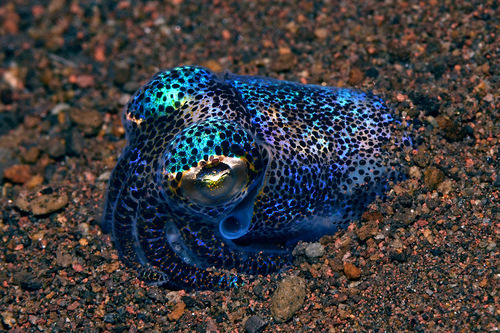
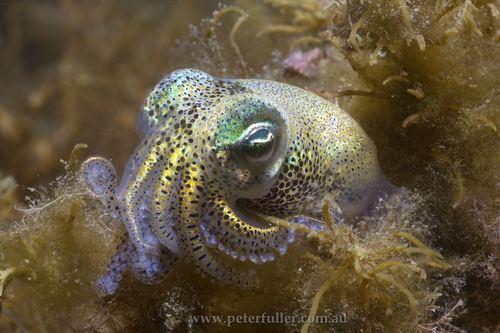
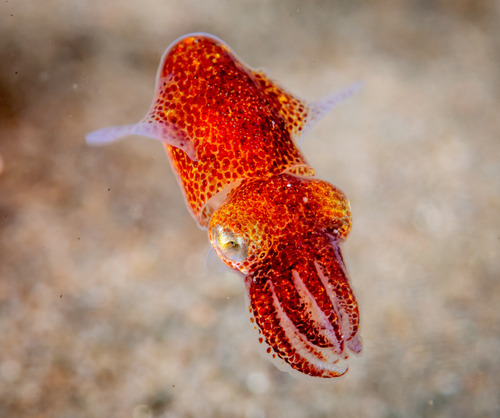
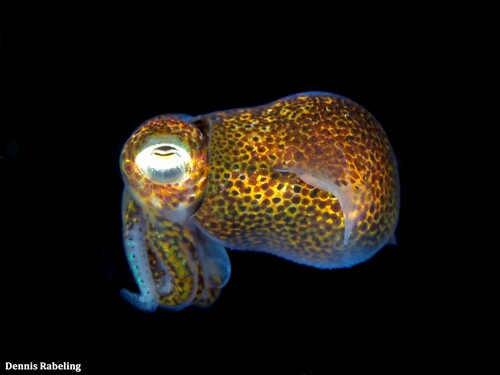
Sepiola atlantica, described by d'Orbigny in 1842, has short fins that do not overlap the mantle margin at either the anterior or posterior ends. Four of its arms have two series of suckers near the body, and 4 to 8 rows of tiny suckers toward their tips. The rest of its arms have two rows of suckers. This species has a modified left dorsal hectocotylus arm. The proximal end of this arm has a fleshy pad made from enlarged and fused sucker pedicels; the copulatory apparatus is a large swollen horn, with secondary lobes at its base. Along the dorsal row of suckers distal to the copulatory apparatus, there are 3 or 4 slightly enlarged suckers with swollen pedicels, followed by 3 or 4 vestigial suckers, then 3 to 5 greatly enlarged suckers roughly halfway along the arm. The hectocotylized arm is strongly bent toward its tip. The tentacular club has 8 suckers arranged in transverse rows. Inside the mantle cavity, there is a pair of kidney-shaped photophores, one located on each side of the animal's ink sac. Both males and females of S. atlantica grow to a mantle length of approximately 21 mm (0.83 in).
This species has a latitudinal distribution ranging from 65ºN to 35ºN. In the north, its range extends from Iceland, the Faroe Islands, and western Norway, southward to the coast of Morocco. There is only one recorded occurrence of this species in the Mediterranean Sea: a mature male caught in the Tyrrhenian Sea at a depth of 90m. The type specimen was collected in the Bay of Biscay and is held at the Muséum National d'Histoire Naturelle in Paris.