About Senna pendula (Humb. & Bonpl. ex Willd.) H.S.Irwin & Barneby
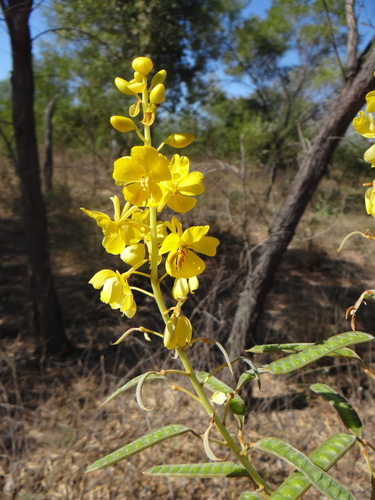
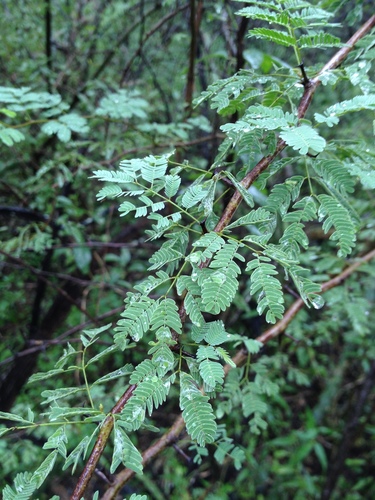
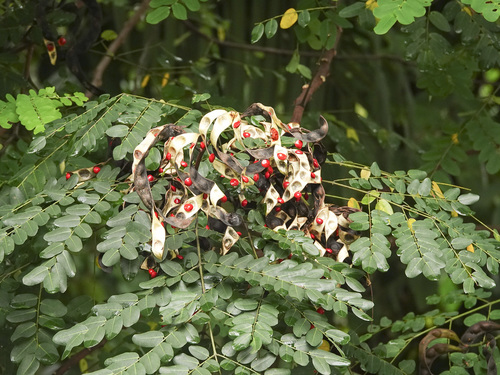
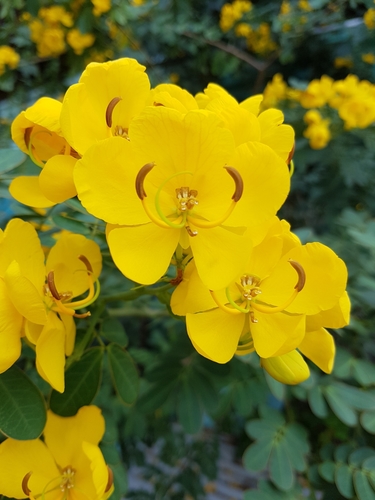
Senna pendula is a fast-growing, spreading, scrambling or erect multi-branched shrub that reaches 2–4 metres in height, with arching stems and branches. It has single-compound, hairless leaves with three to six pairs of wide leaflets, each 1–5 cm long and 5–20 mm wide, with rounded tips and prominent yellowish margins. This species can be distinguished from the closely related Senna bicapsularis by several features: Senna bicapsularis has only 3 pairs of leaflets per leaf, while Senna pendula has 4–7 pairs of leaflets per leaf and a gland between each pair of leaflets. Senna bicapsularis produces flowers on relatively short pedicels (flower stalks) less than half a centimeter long, while Senna pendula has flowers on longer pedicels that measure 1 to 3 cm. Senna pendula may flower as early as late summer, while Senna bicapsularis blooms from late autumn to winter. Senna pendula was introduced as a garden plant to Australia in 1957, where it was listed in a Brisbane nursery catalogue as "a useful shrub bearing masses of buttercup-shaped flowers in autumn and early winter". In mid-20th century Australia, the plant was much sought after, and gardeners paid four shillings to purchase it. It was sold in nurseries for many decades, but it is no longer sold today due to its invasive nature. In Florida, Senna pendula is commonly cultivated and misidentified as Senna bicapsularis. An investigation of herbarium specimens from the University of Florida, University of South Florida, and Fairchild Tropical Botanic Garden indicates that true Senna bicapsularis is very rare in cultivation in Florida, while Senna pendula is far more common and widespread.