About Senna hirsuta (L.) H.S.Irwin & Barneby
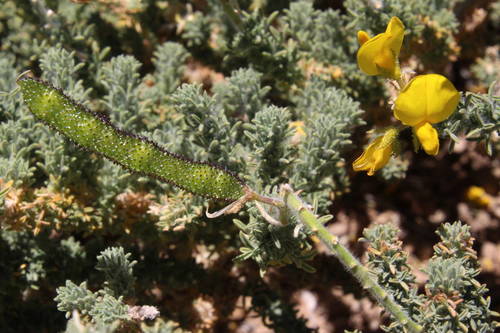
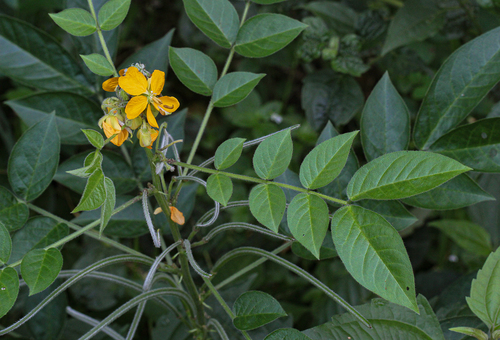
Senna hirsuta (L.) H.S.Irwin & Barneby is an erect or spreading shrub or herbaceous perennial that typically grows up to 2.5 metres (8 feet 2 inches) tall. Its leaves are pinnate, 100–160 millimetres (3.9–6.3 inches) long, growing from a petiole 40–65 millimetres (1.6–2.6 inches) long. The leaves usually have two to six pairs of egg-shaped leaflets, sometimes with the narrower end toward the base. Individual leaflets are 40–90 millimetres (1.6–3.5 inches) long and 20–35 millimetres (0.79–1.38 inches) wide, and are usually spaced 20–40 millimetres (0.79–1.57 inches) apart. A sessile gland is present at the base of the petiole. The yellow flowers are arranged in groups of two to five at the ends of branches and in upper leaf axils, growing from a peduncle about 10 millimetres (0.39 inches) long, with each flower borne on a pedicel 12–20 millimetres (0.47–0.79 inches) long. The petals are 12–16 millimetres (0.47–0.63 inches) long; there are six fertile stamens with anthers 3–8 millimetres (0.12–0.31 inches) long that differ in length, plus four staminodes. Flowering occurs in most months of the year. The fruit is a flattened cylindrical curved pod 100–140 millimetres (3.9–5.5 inches) long and 4–6 millimetres (0.16–0.24 inches) wide. Senna hirsuta is native to most South American countries, Nicaragua, Honduras and Cuba in Central America, and Arizona, New Mexico, Mexico and Puerto Rico in North America. It is also naturalised in countries across Africa, South Asia and Southeast Asia, and in Queensland, Australia. Varieties have restricted native ranges: variety acuminata is only found in south-east Brazil; variety glaberrima is native to Arizona and New Mexico, and naturalised in northwest Mexico; and variety leptocarpa is native to southeast Brazil, Colombia and Paraguay.