About Senecio spartioides Torr. & A.Gray
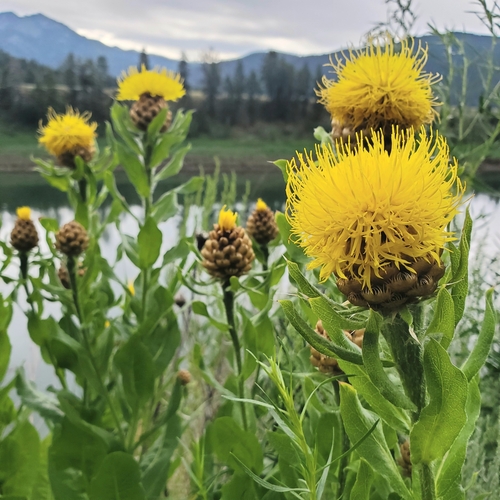
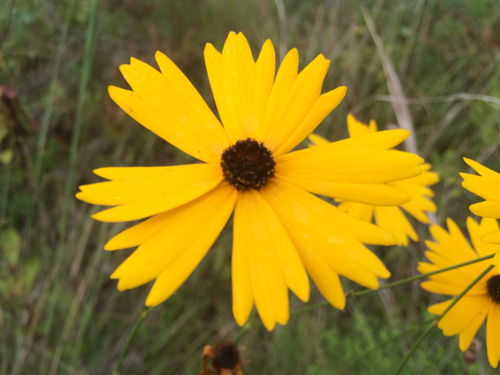
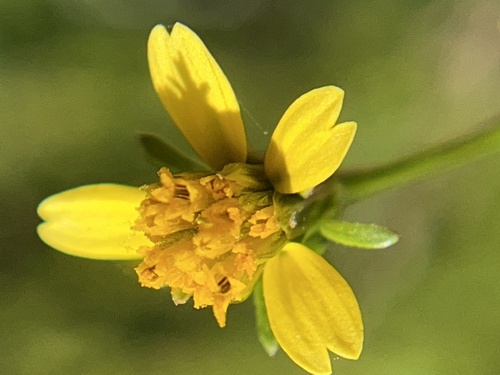
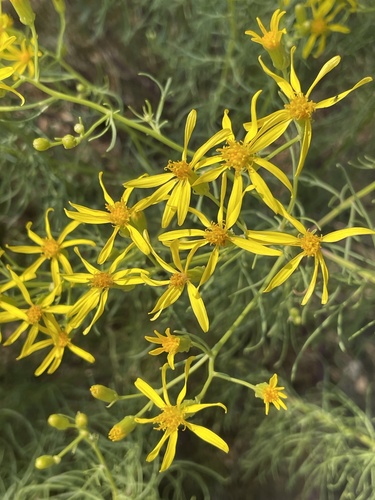
Senecio spartioides is a species of flowering plant in the aster family, commonly known as broom-like ragwort. It is native to the western United States, ranging east as far as the Dakotas and Texas, and northern Mexico. It grows in dry, rocky, often disturbed areas across a variety of habitat types. It is a subshrub that can grow taller than one meter in height, with arching stems that grow from a taproot with a woody upper portion. Its leaves are linear in shape, reaching up to 10 centimeters long. Most leaves have smooth, unlobed edges, though slightly lobed leaves occur occasionally. Leaves are spread evenly along the stems, but lower leaves wither away early. This gives the plant a bare lower half, while the upper portion remains lush green and in bloom. Its inflorescences are spreading, flat-topped clusters holding many cylindrical flower heads. Each head contains yellow disc florets, and generally either 5 or 8 yellow ray florets that are each about one centimeter long. The silvery white pappus hairs of Senecio spartioides, which carry the tiny brown seeds through the air, attract as much attention as the plant’s golden yellow flowers. This type of pappus hair is common for many members of the Sunflower Family, and is most famously seen in dandelions, Taraxacum officinale. The specific epithet spartioides comes from the Greek root oid, meaning “similar to”, so spartioides means “similar to Spartium”, a genus in the Fabaceae, or pea, family. This species was first collected by John C. Fremont along the Sweetwater River in Wyoming in 1842. It was formally named and described by Torrey and Gray in their Flora of North America in 1843. This species has been recorded hybridizing with other species in the Senecio genus.