About Senecio inaequidens DC.
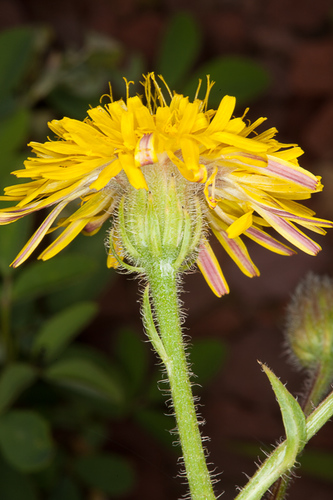
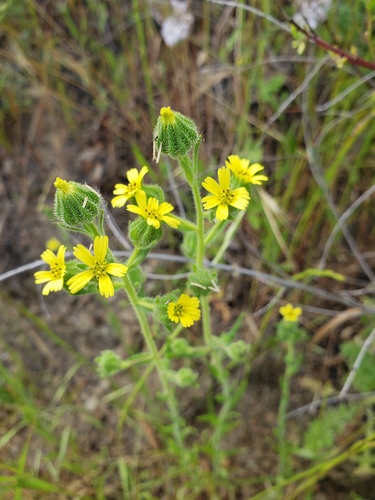
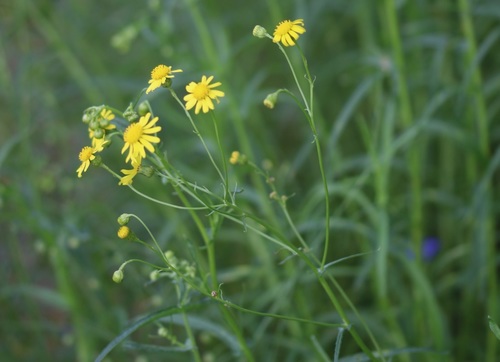
Senecio inaequidens DC. is a perennial chamaephyte that reaches up to 1 meter (3 feet 3 inches) in height. It is often highly branched, with each stem ending in one or a few yellow capitula that form a loose floral display. A single individual produces between 26 and 500 capitula per year. Each capitula holds approximately 90 florets, and around 74% of these florets develop into a viable achene. Its leaves are linear, entire or nearly entire, and lack petioles. This species occurs as both a diploid genotype and a tetraploid cytotype. Early researchers incorrectly classified the diploid form as two separate species, Senecio madagascarensis and Senecio harveianus, but molecular analysis has confirmed these are only different cytotypes of Senecio inaequidens, not distinct species. Senecio inaequidens is native to Southern Africa, where it grows in Lesotho, South Africa, Eswatini, Namibia, Mozambique and Botswana. In its native range, it grows at elevations ranging from sea level up to 2,850 meters. It inhabits a wide variety of both naturally and anthropogenically disturbed habitats, including river banks, rocky slopes, heavily grazed or recently burned grasslands, and road verges. The tetraploid cytotype is only found in the uKhalhamba and Maloti mountain ranges in its native range, and this is the cytotype that was accidentally introduced to Europe.