About Senecio hispidulus A.Rich.
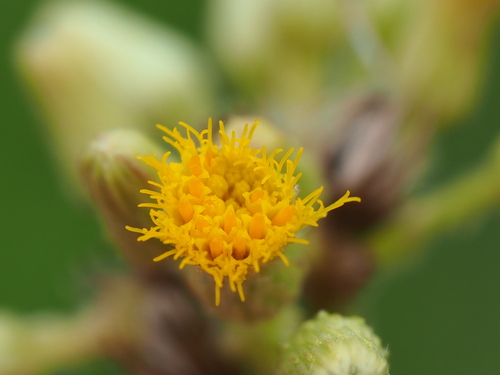
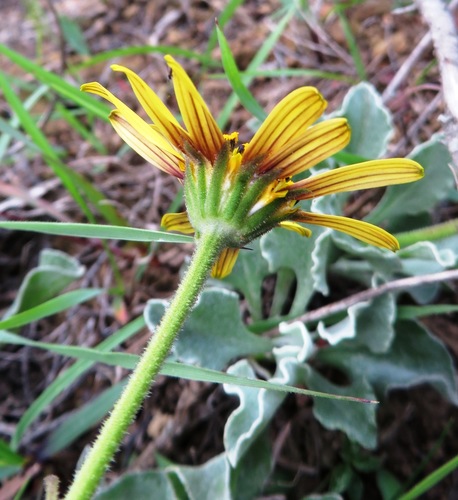
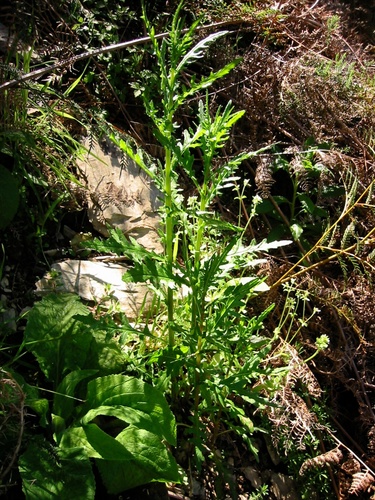
Senecio hispidulus A.Rich. is an erect dicotyledonous vascular flowering herb with an annual or short-lived perennial life cycle. It can reach up to 2 metres tall, but most individuals grow between 30 and 100 cm tall. This herb is sparsely to moderately covered in coarse hairs: shorter hairs grow on upper leaf surfaces, while longer, denser jointed hairs grow on lower leaf surfaces. Its main primary stem is usually simple, covered in conspicuous soft bristly hairs, and the plant has a woody base that develops into a ribbed mid stem. Mid stem leaves are evenly spaced and sized, typically 70 to 150 mm long, and range in color from dark green to yellow green, sometimes with red shading. The upper stem can also be tinged with purple or red, a change triggered by environmental temperatures. Larger lower leaves have sinuately pinnately lobed margins, usually with three to five teeth and a terminal tooth longer than the lateral teeth. The smaller uppermost leaves, located closer to the inflorescence, are usually dentate rather than lobed. Mature lobed leaves have a distinctive relatively narrow shape, with between 2 and 5 lobes along their side margins. The plant produces many small yellow or pale-yellow inflorescences, made up of multiple capitula (flower heads). Most mature plants hold between 14 and 48 capitula, with each capitulum containing 25 florets, though this number varies between the two geographically separated components of the species found in New Zealand. Mature florets are usually 6 to 12 mm long and 4 mm wide. The seeds of S. hispidulus are hairy, a trait linked to the genus name: Senecio comes from Latin for 'old man', referencing the 'bearded' hairy seeds. Seeds are small, typically around 0.5 mm wide and 2 mm long. In New Zealand, S. hispidulus is represented by two geographically segregated components: one grows north of 39° south latitude, and the other grows south of this point. The primary differences between the two components are the number of capitula and the number of florets per capitulum on mature plants. The northern component averages 14 capitula per plant, with 26 to 31 florets per capitulum, while the southern component averages 48 capitula per plant, with 17 to 24 florets per capitulum. There is also a difference in the number of polliniferous (pollen-bearing) florets per capitulum: the northern component has 9 to 11 polliniferous florets per capitulum, while the southern component has 5 to 8. Both components have roughly equal numbers of female florets and polliniferous florets, a difference that may indicate differing reproductive needs between the two groups. This geographic separation (with a documented break in the species' range between 38° and 40° south latitude) does not support the hybridization hypothesis, which Drury notes lacks geographic support. S. hispidulus is indigenous to New Zealand and Australia. In Australia, it occurs predominantly in New South Wales, and is also found in Tasmania, Western Australia, and Queensland. In New Zealand's North Island, it occurs mainly around the Auckland isthmus, Coromandel, Ōpōtiki, and Wellington Province. In the South Island, its range includes Nelson, Marlborough, and North Canterbury. D. G. Drury has suggested that plants in northern North Island may be naturalized in New Zealand, while there is currently insufficient evidence to determine whether plants from northern South Island and the Wellington area are indigenous or naturalized. S. hispidulus occupies habitats ranging from coastal to montane environments, most commonly at sites where native vegetation has recently been burned or cleared. It grows from sea level up to 457 metres (1,500 ft) above sea level, and is most common in dry, bare or disturbed, unstable habitats including recently cleared or burned areas. It also frequently grows on forest margins, coastal sites, and riverbeds. Growth can occur year round depending on environmental conditions, which explains the wide range of plant heights seen in the species; plants in good conditions can grow year round, while those in suboptimal conditions cannot. This adaptability is also seen in its flowering period: estimates range from October to April, while the New Zealand Plant Conservation Network lists it as August to May, and flowering generally occurs between spring and summer. S. hispidulus is a strongly invasive species that grows easily from seed. When flowering, it produces both polliniferous florets and female florets, a trait that increases its chance of reproduction when cross-pollination is hindered. Senecio hispidulus is believed to cause livestock poisoning and death. All Senecio species contain pyrrolizidine alkaloids (PA), which are harmful to humans, causing damage to the liver and lungs, and are linked to poisonings and livestock losses. PA are also classified as a type of carcinogen.