About Senecio coronatus (Thunb.) Harv.
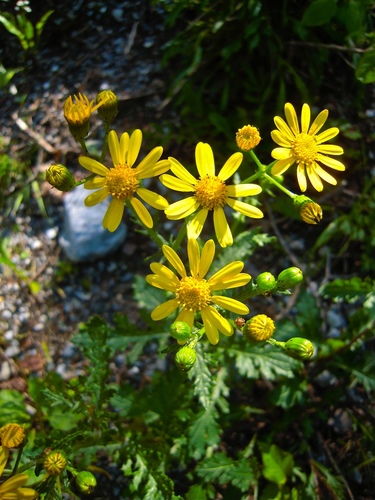
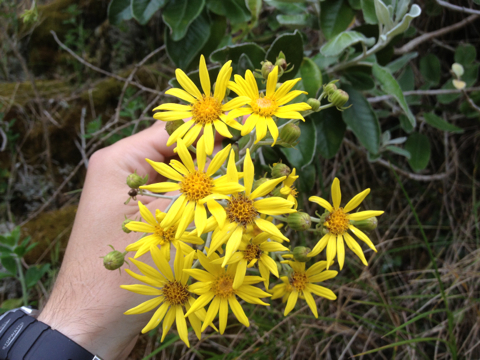
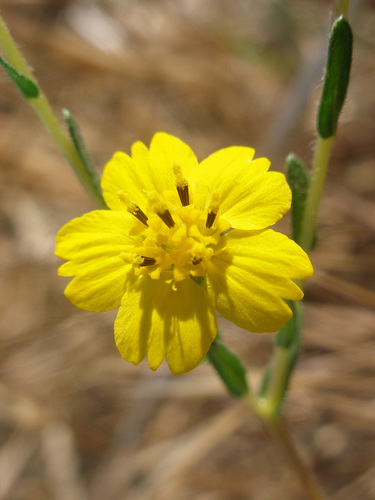
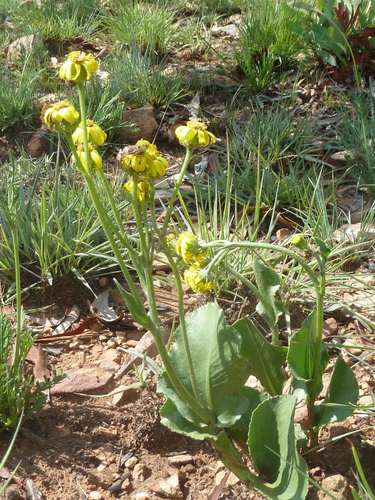
Senecio coronatus (Thunb.) Harv., also known as the woolly grassland senecio, is a member of the plant family Asteraceae. This species is endemic to Southern Africa, where it is widespread across the moister southern and eastern regions of the area. It is a perennial plant that grows from a large, thick underground woolly-covered rootstock. It produces large, leathery, erect broadly elliptic leaves. Between 3 and 20 capitula (flower heads) are arranged in a terminal corymb cluster, each bearing roughly 10 slender yellow ray florets. Its rootstock is thick, very woolly. Stems are herbaceous, erect, terete (cylindrical), ribbed-striate, loosely woolly on the lower sections, and cobwebbed, becoming glabrous (hairless) towards the top, ending in a few-headed corymb. Stems grow 6 inches to 2 feet high, with sparse leaves and are bare of leaves in the upper portion. Lower root leaves are several, borne on longer or shorter petioles, measuring 3–6 inches long and 1 1/2–3 inches broad, varying considerably in their relative length and breadth. Lower leaves are broadly ovate or oblong-obovate, tapering at the base into a petiole, subacute, penninerved, minutely calloso-crenulate; younger lower leaves are loosely cobwebbed, while older leaves are glabrous and rigid. Upper stem leaves are sessile, stem-clasping, shaped ovate, oblong or lanceolate, growing smaller as they progress up the stem. Cauline (stem) leaves are few and spaced apart, and can be either broad or narrow. Young plant parts are loosely covered in cobweb-like hairs. The corymb holding the flower heads can be simple or branched, with long, naked pedicels. All flower heads are many-flowered and radiate. The involucre is calycled with long, subulate bracteoles, and can be either glabrous or cobwebbed, made up of 20 or more keeled, subulate scales. Flower heads are similar in appearance to those of Senecio albanensis. Ray florets are numerous, long, and yellow. Achenes are short, subcompressed, and variably hairy, sometimes densely hairy and sometimes sparsely hairy. A named variant (Var. β) is more slender, with smaller leaves and smaller heads, but is otherwise identical to the species type.