About Sempervivum globiferum L.
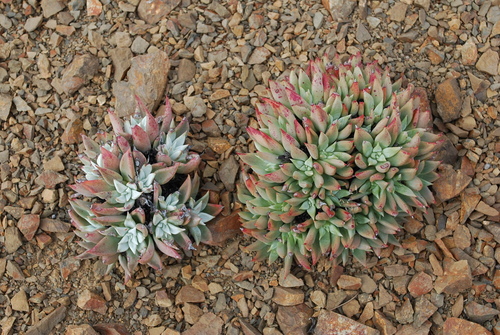
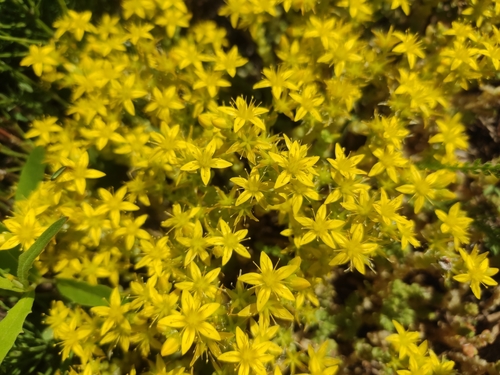
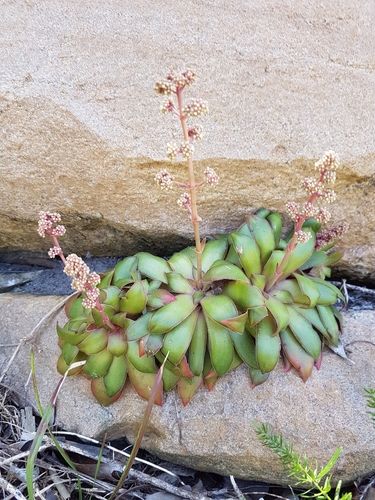
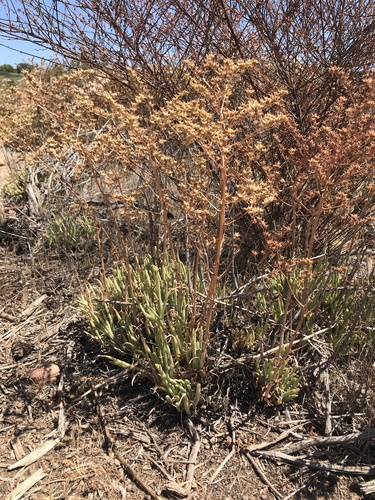
Sempervivum globiferum L. (also referred to as Jovibarba globifera, common name rolling hen-and-chicks) is a perennial herb. It forms a hemispherical leaf rosette that is 2.5–4 centimetres (0.98–1.57 in) wide, and produces a flower stem 10–20 centimetres (3.9–7.9 in) tall. The leaf blades on the rosette are spatulate, curved, fleshy, and have smooth entire margins; they usually have reddish-brown tips, while the leaf blades growing on the flower stem are ovate. The flowers are pale greenish-yellow or yellow, actinomorphic (radially symmetrical), and bell-shaped, with six petals. Each flower is about 1 centimetre (0.39 in) wide, and blooming occurs from June to August. This species produces small, globe-shaped offsets called "globi", which attach loosely to the mother plant and easily detach to roll away. The main rosette is monocarpic (dies after flowering and reproduction), while the offsets survive to grow into new plants. Rolling hen-and-chicks reproduces both asexually via these offsets and sexually via seeds. This plant is distributed in the eastern and southern Alps, the Carpathians, and the western Balkans, extending south to northern Albania. It grows in mountainous rocky habitats at elevations between 1,100 and 2,200 metres (3,600–7,200 ft) above sea level.