About Semotilus thoreauianus Jordan, 1877
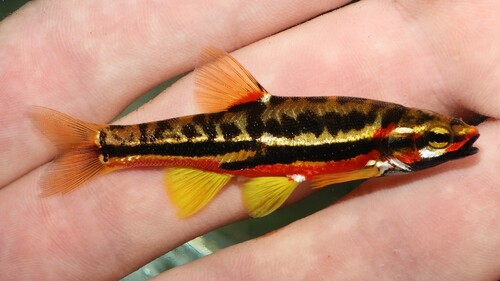
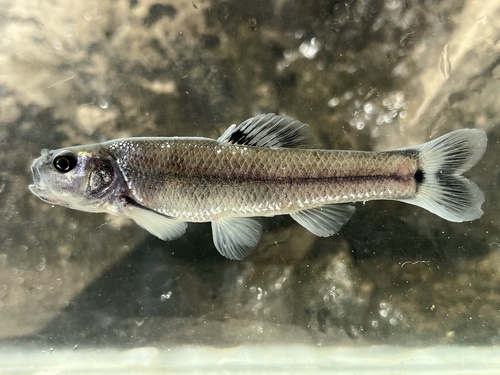
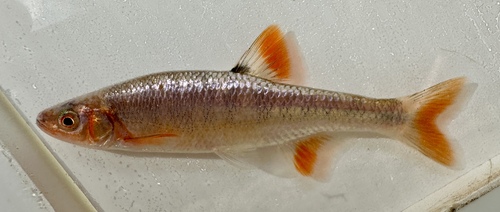
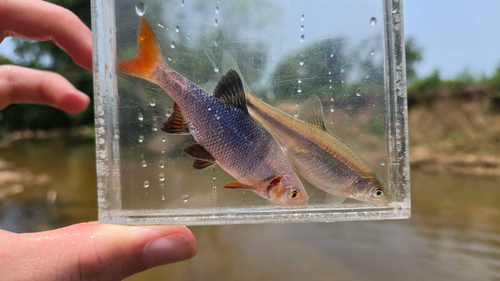
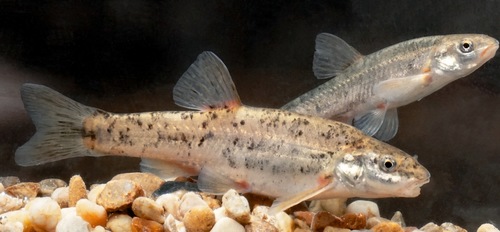
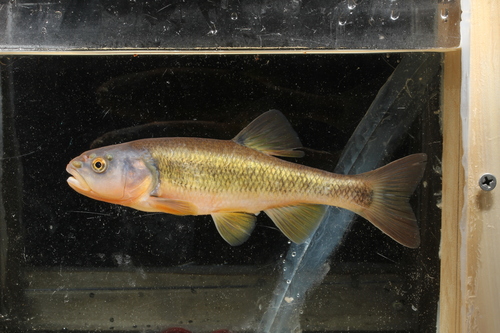
Description: The Dixie chub (Semotilus thoreauianus) is similar in overall shape to the closely related creek chub (Semotilus atromaculatus), but it is typically more robust and shorter than the creek chub. It also has larger, fewer lateral line scales than S. atromaculatus. The origin of the Dixie chub's dorsal fin sits behind the origin of the pelvic fin; in S. atromaculatus, the dorsal fin origin lies directly over the pelvic fin origin. Spots on the dorsal and caudal fins of the Dixie chub are less distinct than those of S. atromaculatus. During the breeding season, male Dixie chubs develop four large, hooked tubercles on each side of the head, and the tubercles closest to the nostrils often become fused. Compared to S. atromaculatus, the Dixie chub has a smaller number of head tubercles on its gill covers and caudal fin. The Dixie chub is generally dark along its back, with undersides colored from orange to pink, and yellow-orange fins. The spot on its caudal peduncle is more diffuse than that of S. atromaculatus. In S. atromaculatus the caudal peduncle spot is normally wedge-shaped and distinct from the lateral stripe, while the equivalent spot of the Dixie chub is quadrilateral and joined to the lateral stripe. The Dixie chub's dark lateral stripe is rather wide but not very distinct. It reaches a total length of 65–150 millimetres (2.6–5.9 in). Distribution: The Dixie chub is endemic to Gulf of Mexico-draining rivers in the southeastern United States, ranging from the Tombigbee River in Alabama to the Ochlockonee River drainage in Georgia and Florida. It has also been recorded from three tributaries of Bear Creek in Colbert County, Alabama, marking the first records of this species from the Tennessee River drainage. The Dixie chub is sympatric with S. atromaculatus in rivers that drain into Mobile Bay, where it occurs in coastal reaches up to the Fall Line, and it replaces S. atromaculatus in areas east of the Conecuh River. Habitat and ecology: Dixie chubs are found in small, clear headwater streams, living in pools of creeks and small rivers with sand or gravel substrates. These fish aggregate to spawn in April. Like S. atromaculatus and S. lumbee, this species builds specific breeding structures called pit/ridge nests. These nests are constructed in flowing stretches near pools that provide a suitable refuge for the guarding male, such as an undercut bank. A dominant male first excavates an initial pit, mates with a female, then begins covering the eggs with small pebbles collected from the substrate, starting at the upstream end of the pit. In subsequent matings, new batches of eggs are laid downstream of the previous batch, covered with more pebbles, and a new pit is excavated downstream, which lengthens the nest ridge. Males guard the nest and display to other similar-sized males by swimming parallel to them. Males will also aggressively lunge at other species that approach the nest. The saffron shiner (Notropis rubricroceus) has been recorded associating with nesting Dixie chubs. The Dixie chub is omnivorous, and has been recorded eating a variety of both animal and plant material, including insects, worms, other fishes, molluscs, crayfishes, and plant matter.