About Semnornis ramphastinus (Jardine, 1855)
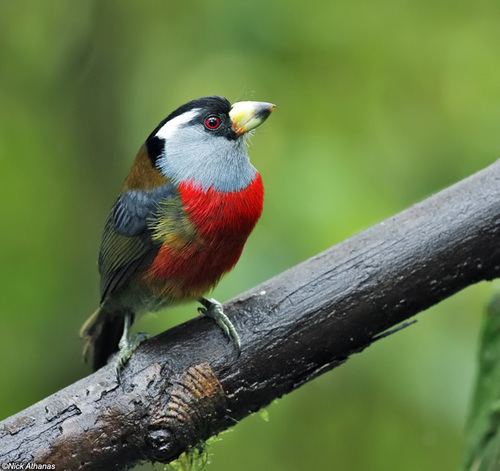
The toucan barbet, scientifically named Semnornis ramphastinus, is a medium-sized, robust barbet. It measures 19 to 21 cm (7.5–8.3 in) in length and weighs between 80–115 g (2.8–4.1 oz). Its beak is robust: the maxilla is yellow and the mandible is light green, with both ending in dark tips. The beak is pronged at its tip, but the prongs cannot be easily distinguished in the field. The species has colorful plumage, with a black crown, black facial mask, and a thin black cervical collar. It has long occipital feathers, a noticeable white stripe behind the eyes, and bright red irises. The nape is golden-brown, and this coloration shifts to yellow toward the rump. The throat, upper breast, and sides of the nape are grayish-blue. The lower breast and middle belly are bright red, while the lower belly is yellowish green. The wings and tail are gray. The subspecies S. r. caucae is very similar to the nominate race, but has less extensive red coloring on the breast. Males and females are almost identical, with only two small differences: the female’s plumage is slightly less bright, and she lacks the tuft on the black plumage of the nape. Immature birds have duller plumage than adults, and do not develop beak prongs until they reach 4 months old.
This species is native to humid forests of the western Andes, occurring on Andean slopes from northwest Ecuador to southwest Colombia, at elevations between 1,400–2,400 m (4,600–7,900 ft). It uses all vertical forest strata, and shows some preference for the upper canopy (11–20 m / 36–66 ft) and the subcanopy (6–10 m / 20–33 ft). It can also live in secondary forest and forest-edge habitats. Toucan barbets are very specific when selecting nesting trees, and generally prefer old trees from the family Lauraceae. Since nesting trees of sufficient diameter are uncommon in these forests, habitat loss from logging negatively impacts the species.
Toucan barbets are typically found in pairs or small groups, perched silently on long horizontal branches, which makes them hard to locate unless they are active or singing. Their flight is fast and noisy. They usually live in small groups of three to six individuals, and are territorial. Territory sizes range between 4–10.6 ha (9.9–26.2 acres), with an average territory size of 5.8 ha (14 acres). Most of a territory is made up of mature forest, though the species can adapt to living in forests that include small areas of secondary forest or pasture. Toucan barbet groups display strong territorial behavior against other groups and other species. Breeding pairs signal territory ownership with loud duets, and actively chase intruders away with help from other helpers in the family group, especially when near the nest. When no outside disturbance occurs, a group can occupy the same territory for one year or longer.