About Semnopithecus priam Blyth, 1844
Physical characteristics: The head-to-body length of Semnopithecus priam ranges from 55 to 80 cm (22 to 31 in), with tail length between 75 and 90 cm (30 to 35 in). Adult individuals weigh 11 to 20 kg (24 to 44 lb), and males are larger than females. The average adult has a weight of 12.8 kg (28 lb) and a head-to-body length of 61.1 cm (24.1 in).
The Indian subspecies has a somewhat larger body than the Sri Lankan subspecies; Sri Lankan individuals typically weigh between 6.8 and 13.4 kg (15 and 30 lb). Even with its smaller average size on the island, the tufted gray langur is the largest native primate in Sri Lanka based on average body size.
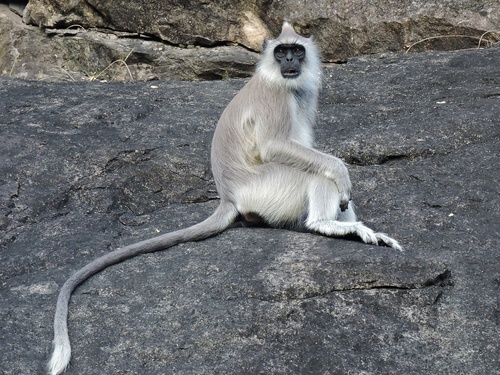
For the Sri Lankan subspecies, the dorsal area ranges in color from gray to brownish gray, and darkens as the individual ages. Its underparts are light grayish, and it has a short whitish beard and sideburns. Crown hairs form a distinct pointed tuft or crest that meets at a central point, which gives the species its common name. Black eyebrows project outward, the head is scarcely paler or not paler than the back, and the hands and feet are the same color as the limbs.
Habitat: In Sri Lanka, tufted gray langurs are abundant in dry zone forests and also live within human dwellings. Large troops are found at archaeologically important sites including Polonnaruwa, Dambulla, Anuradhapura, and Sigiriya. They also occur in southern areas of the island such as Hambantota, Yala National Park, and Tissamaharama.
Ecology: Tufted gray langurs are generally shy animals. They are partially arboreal, semi-terrestrial, and diurnal. They will come down to the ground when there is no danger. Unlike their canopy-dwelling sympatric relatives, they are quite common in urban settlements, and can be found in gardens and on large fruit trees such as Mangifera indica and Artocarpus heterophyllus.