About Semisulcospira libertina (A.Gould, 1859)
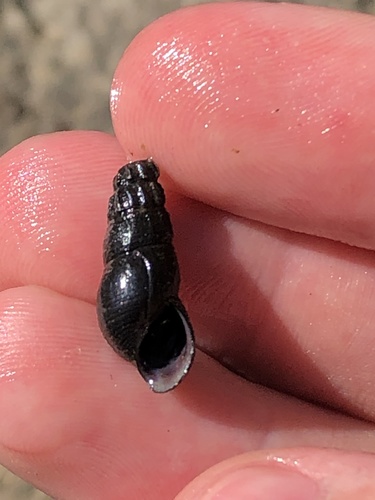
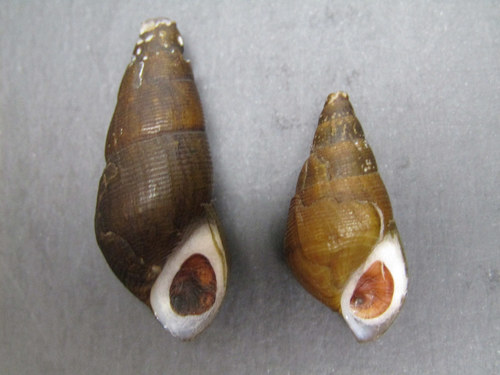
Semisulcospira libertina (A.Gould, 1859) has a shell with 4–6 whorls, and its apex is usually eroded. The spire is long, the aperture is continuous with a simple lip, and the umbilicus is closed. Shell shape and sculpture of this species are very variable. It has seven or more, up to 12, basal cords, which are spiral sculptures at the base of the body whorl. Transverse ribs sometimes appear in its shell sculpture, with 12–18 ribs per penultimate whorl. Its periostracum is smooth. Shell color is usually light yellow, and very rarely can be light brown; the spire is a darker yellowish-brown. Some shells have purple-brown spiral bands, with 1, 2, or 3 bands per shell. The average shell width is 11.0–13.0 mm (0.43–0.51 in), and average shell height is 26.0–28.6 mm (1.02–1.13 in) for specimens from Japan. For specimens from Korea, average shell width ranges 12.55–19.37 mm, average shell height is 6.44–9.20 mm, average total wet weight is 0.24–0.86 g, average shell weight is 0.16–0.62 g, and average meat weight is 0.09–0.39 g. Extremal dimensions recorded from another Korean locality show total wet weight ranges from 0.30 g at 9.87 mm shell height to 1.55 g at 22.57 mm shell height. The shell mineral composition is 52.9% CaO, 0.77% SiO2, 0.36% Na2O, 0.06% Al2O3, 0.05% Fe2O3, 0.01% MgO and 0.01% P2O5. Citrulline makes up 45.44% of the free amino acids found in this species' blood. Nelson Annandale first illustrated this species' operculum and radula in 1924, and Ko et al. (2001) described the radula in detail. The operculum is ovate, flat in profile, paucispirally coiled, and has an eccentric nucleus. Cephalic tentacles are short, approximately the same length as the snout. Males have a reproductive system made up of testis, vas deferens, and spermatophore organ, with no penis. Females have a reproductive system made up of ovary, pallial oviduct, spermatophore bursa, seminal receptacle, and brood pouch. The diploid chromosome number of S. libertina is 2n=36. Its complete 15,432 bp mitochondrial genome has been known since 2015, and this was the first mitochondrial genome resolved for any species in the superfamily Cerithioidea. The closely related species Semisulcospira reiniana differs in having larger ribbed embryos, more slender adult shells, and a diploid chromosome number of 2n=40. This species occurs in continental South Korea, Jeju Island, central China's Hubei, eastern China's Anhui, Fujian, Jiangxi, Zhejiang, southern China's Guangdong, Taiwan, and widespread across Japan, where it is the most common freshwater snail. It has also been reported from the Philippines. Gould's 1859 original type locality listing was "Simoda and Ousima", referring to Shimoda City on Honshu and Amami Ōshima in the Ryukyu Islands. Davis (1979) identified the presumed type locality as Inozawa River, Inozawa Section, Shimoda City, Izu Peninsula, Shizuoka Prefecture, Honshu (Site 1 in Figure 4). A 2013 study by Miura et al. of mitochondrial haplotypes from Korean and Japanese S. libertina found mixed haplotypes in Korea, indicating long-distance paleo-migration across the Korea Strait from Japan to Korea. Shells of this species have also been found in the Nojiri-ko Formation at Lake Nojiri in central Japan, dating to 27,000 years BP. Habitats for S. libertina include pools, slow-flowing rivers, drainage ditches, rice paddies, and streams. A 1970 study by Kim of Korean populations recorded habitat water temperatures ranging 1.3–22.5 °C. This species has a pollution tolerance value of 3 on a 0–10 scale, where 0 indicates the best water quality and 10 indicates the worst. High cadmium concentrations may affect the behavior of this snail. Semisulcospira libertina is gonochoristic, meaning each individual is distinctly male or female, and it is ovoviviparous. All larval development takes place inside the female's brood pouch. Eggs develop through the trochophore, preveliger, and veliger stages before becoming juveniles, and embryos contain a large amount of yolk. Development from egg to veliger takes 17 days at 25 °C. Full development takes about 8 months in winter and about 2 months in summer. Embryos do not have ribs on their shells, but usually have 1–2 spiral cords. Embryos are brown, sometimes yellow. A female holds over 80 small embryos in her brood pouch. The average number of embryos is 58–124 in July, and 222–570 in November. A single female typically gives birth to 607–858 newborn snails per year, with a recorded maximum of 1535 newborns in one year. Females give birth at water temperatures between 12 °C and 24 °C, and birth mainly occurs in two periods: March–May and September–October. Newborn snails have shell widths of 0.60–0.99 mm, with a maximum of 1.22 mm, and shell heights up to 1.73 mm. Newborn shells have 2.0–3.5 whorls. The typical life span of S. libertina is about 2 years.