About Semicassis granulata (Born, 1778)
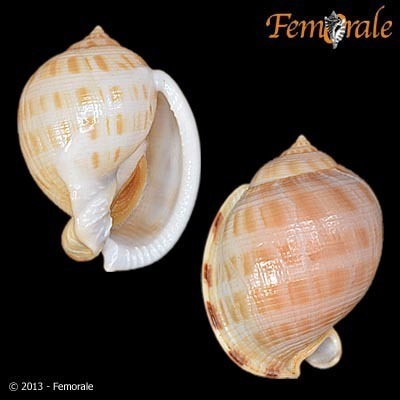
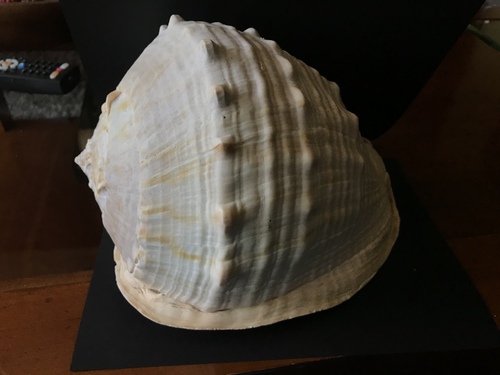
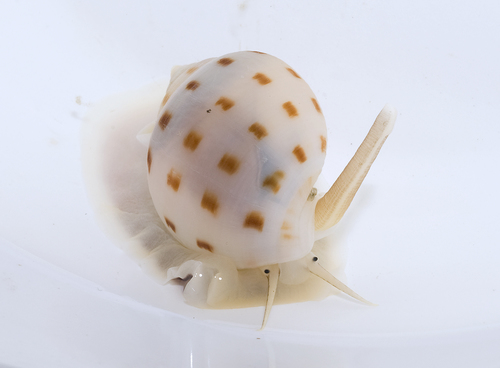
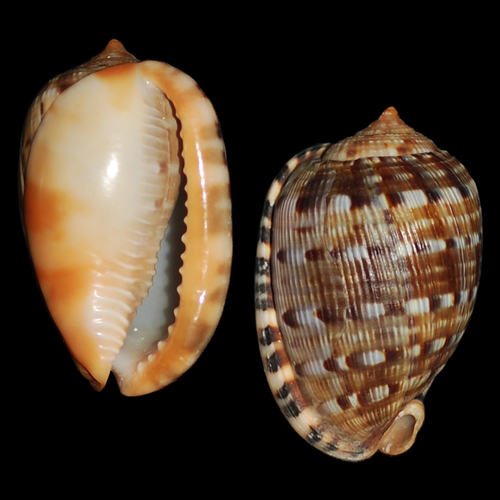
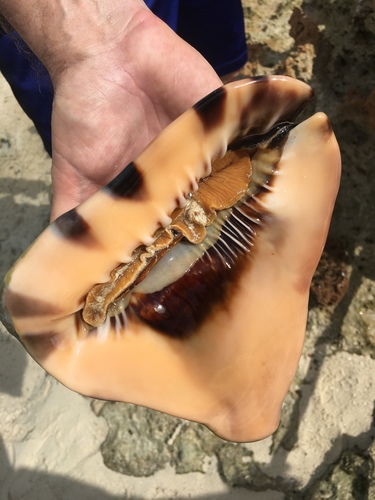
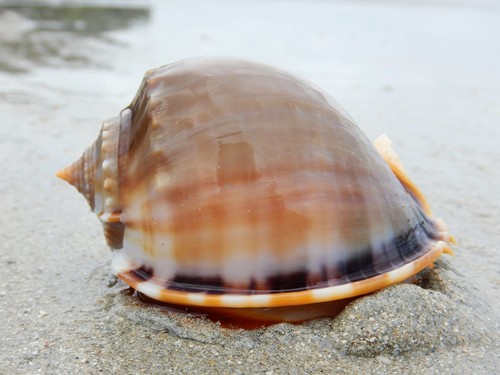
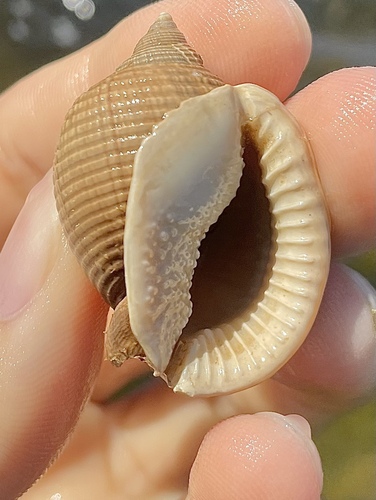
Semicassis granulata, commonly known as the Scotch bonnet, is a medium-sized to large species of sea snail, a marine gastropod mollusk in the subfamily Cassinae, which includes helmet shells and bonnet shells. The common name "Scotch bonnet" refers to the shell's general outline and color pattern, which vaguely resemble a tam o' shanter, a traditional Scottish bonnet or cap. The shell is egg-shaped and ranges from 2 to 4 inches (5 to 10 cm) in maximum dimension, with a regular pattern of yellow, orange, or brown squarish spots. The surface sculpture of the shell is highly variable: the surface can be smooth and polished, have grooves, be granulated, or even be nodulose on the shoulder of the whorls. This species lives in intertidal and subtidal areas on sandy substrates, and is found primarily in the tropical and subtropical Western Atlantic Ocean, ranging from North Carolina to Uruguay. It is the most common species in subfamily Cassinae in North America. A similar-looking sea snail found in the Mediterranean Sea and Northern Atlantic Ocean, Semicassis undulata, is currently classified as a separate species. The exact taxonomy of Semicassis granulata has been unclear historically; in addition to the current accepted name combination, 38 other combinations and synonyms exist. In the spring, adult females of this species lay eggs in tower-shaped structures. The eggs hatch into veliger larvae, which can float in the plankton for up to 14 weeks before settling onto the seabed as tiny snails. Crabs are predators of this sea snail. After the snail dies, intact empty shells are often used by hermit crabs. In 1965, the Scotch bonnet shell was named a state symbol of North Carolina in the United States, marking the first designation of an official US state shell. There are published records of the nominate subspecies Semicassis granulata granulata from several warm-water and tropical areas of the Western Atlantic Ocean. Regions and countries where this species occurs include the US East Coast: North Carolina, South Carolina, Georgia, and Florida (East Florida, West Florida, and the Florida Keys). It has also been recorded on the US Gulf Coast, including Louisiana and Texas. The species is found on the Caribbean Coast of Central America, including Mexico (Quintana Roo), Nicaragua, Costa Rica, Panama and Colombia, as well as Venezuela (Gulf of Venezuela, Carabobo, Sucre, Isla Margarita and Los Testigos Islands). It also occurs in Bermuda, the Greater Antilles, Cuba, Jamaica and Puerto Rico, and further south along the Atlantic coast of South America in Suriname, Brazil (Amapá, Maranhão, Ceará, Rio Grande do Norte, Pernambuco, Alagoas, Bahia, Espírito Santo, Rio de Janeiro, São Paulo, Paraná and Santa Catarina), and Uruguay. As of 2009, this species had apparently not been reported in the scientific literature as occurring in the Lesser Antilles. In contrast, the species Semicassis undulata occurs in the Mediterranean Sea, and parts of the North Atlantic Ocean, including Portugal and the Azores. Semicassis granulata lives on sandy substrate in moderately shallow water, as well as in rocky tide pools close to the shore. Off the coast of North Carolina, divers and local fishermen frequently find Scotch bonnets at depths of about 50 to 150 feet (15 to 46 m); however, live specimens can be found at depths ranging from 0 to 308 ft (0 to 94 m). Empty shells have been found at depths of up to 318 ft (97 m). These snails are often found associated with offshore Atlantic calico scallop beds, probably attracted by the abundant food available there. Shipwrecks also appear to provide good habitat for this species. Scotch bonnets are predators. They search for food on sandy areas of the ocean floor, where they consume echinoderms such as sand dollars, sea biscuits, and other sea urchins (including Echinocardium cordatum), drilling into their tests with the help of sulfuric acid. During spring, favorable food supplies, adequate light, and optimum water temperature create good conditions for breeding and early growth. At this time, female Scotch bonnets deposit hundreds of egg capsules in tower-shaped structures about 4 to 5 inches (10 to 13 cm) high. Males fertilize these eggs. After fertilization, the eggs develop into trochophore larvae, then hatch as free-swimming microscopic veliger larvae that can be carried some distance by ocean currents. Growth is slow, and veligers remain drifting with ocean currents for up to 14 weeks. As veligers mature, they develop their first smooth shell called the protoconch and become very small juvenile snails, at which point they sink to the ocean floor. As with all shelled mollusks, the mantle secretes the shell; shell growth begins at what will later become the apex of the shell, and typically rotates clockwise. As the animal gradually matures, the mantle continues to secrete new shell material. Scotch bonnets reach full maturation in one to six years, though some individuals have lived longer than six years. After death, the empty shell of this sea snail is often used by hermit crabs. A study of shell use by the diogenid hermit crab species Isocheles sawayai on the coast of Caraguatatuba, Brazil, found that 11.5% of this hermit crab population was using shells of Semicassis granulata. The study reported that shell occupation was not random, and was instead influenced by the weight, size, shape and internal volume of the shell, the presence of epibionts such as bryozoans on the shell, and the degree of resistance the shell provided against predation and desiccation. In 1965, the US state of North Carolina named the Scotch bonnet as its official state shell, to honor the abundance of Scottish settlers who founded the state. With this designation, North Carolina became the first state in the US to have an official state shell. Populations of S. granulata have been declining due to increased collection and accidental harvesting by commercial fishermen.