About Semibalanus cariosus (Pallas, 1788)
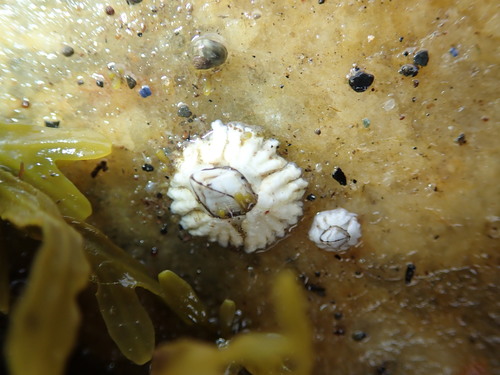
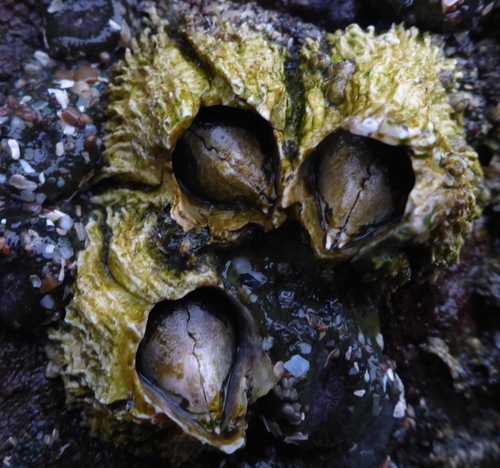
This species of barnacle, Semibalanus cariosus, has six wall plates sculpted with vertical tube-like ribs. These ribs extend down onto the rock in projections that resemble the edge of a thatched roof. The rostrum overlaps the wall plates, and when the barnacle is closed, the terga form a beak shape. A sinuous line runs along the junction between the tergum and the scutum. This is a large barnacle species that can grow up to 6 cm (2.4 in) in diameter. When individuals are densely packed together, they often grow much taller than they are wide. The wall plates can be white, greenish, brownish, or gray. The base of the barnacle is only lightly calcified, so when it is broken away from rock, a membrane and some soft tissues may be left behind.
Semibalanus cariosus is native to the northern Pacific Ocean, including Japan and the Pacific Northwest coast of North America. Its range extends from the Bering Sea to Morro Bay, California. It grows on rocks, pilings, and other man-made structures, from the mid-intertidal zone down to the shallow subtidal zone. It typically occupies a belt below the zone where Balanus glandula lives, and is often found near beds of the California mussel (Mytilus californianus) and the bay mussel (Mytilus trossulus). It can be very abundant, and is often the most common organism in this belt.
Like other acorn barnacles, S. cariosus is a filter feeder. When submerged under water, the movable terga at the apex of the barnacle open, and its cirri are extended to catch food. When out of water, the terga close tightly to protect the barnacle and prevent desiccation. Small individuals of this species are sometimes pushed off rocks by the grazing limpet Lottia digitalis. Predatory gastropod mollusks such as the channeled dog winkle (Nucella canaliculata) drill into the barnacle's shell and inject a toxin that relaxes its muscles, allowing the winkle to eat the barnacle's soft tissues. Winkles are more successful at entering the barnacle when they drill between the wall plates rather than through the plates themselves. Larger barnacles are often too large to be preyed on by the frilled dogwinkle (Nucella lamellosa), the purple seastar (Pisaster ochraceus), or the sunflower sea star (Pycnopodia helianthoides).
Native American groups including the Quinault people of Washington State used this barnacle as a food source. Barnacles were counted among staple foods in spring and summer alongside clams, oysters, mussels, roots, berries, and fish. Shells of Semibalanus cariosus have been found in Quinault middens.