About Semibalanus balanoides (Linnaeus, 1767)
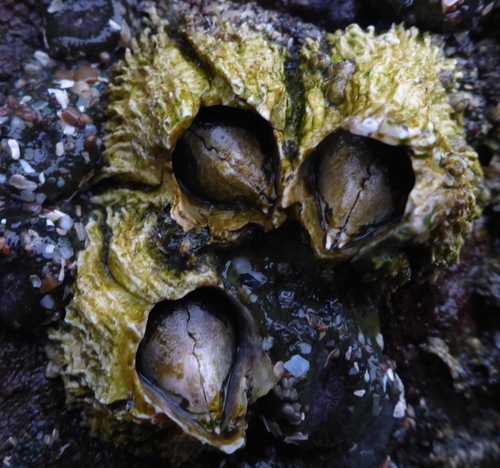
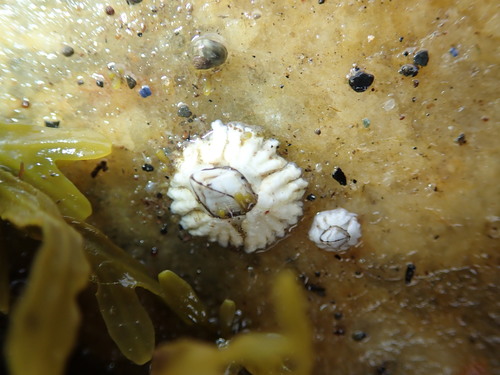
Adult Semibalanus balanoides grow up to 15 millimetres (0.6 in) in diameter, and are sessile, living attached to rocks and other solid substrates. They have six greyish wall plates surrounding a diamond-shaped operculum. Unlike other barnacles that have calcified bases, the base of the S. balanoides shell is membranous. When rising tide covers the barnacles, the operculum opens, and feathery cirri (modified thoracic appendages) are extended into the water to filter food from seawater. When the tide falls, the operculum closes again to prevent desiccation. It is believed that the reduction from the primitive eight wall plates to six decreases water loss further by reducing the number of sutures through which water can escape.
Semibalanus balanoides is found in the intertidal zone of the world's northern oceans. Its northern distribution is limited by the extent of pack-ice, while its southern distribution is limited by increasing temperatures that prevent gamete maturation. For S. balanoides to breed, the mean monthly sea temperature must drop below 7.2 °C (45.0 °F). In Europe, this species is found on Svalbard and from Finnmark to north-west Spain, but does not occur in part of the Bay of Biscay. It is common across the British Isles, except in parts of Cornwall, the Scilly Isles and south-western Ireland. On the Atlantic North American coast, it reaches as far south as Cape Hatteras, North Carolina, and on the Pacific North American coast, it reaches as far south as British Columbia. S. balanoides is the most common and widespread intertidal barnacle in the British Isles, and it is the only intertidal barnacle of the north-east coast of North America.
Semibalanus balanoides can be the dominant species of rocky shores, growing in a range of locations from very sheltered to very exposed shores. It is typically found lower on the shore than another barnacle, Chthamalus montagui, though the two species have some overlapping range. S. balanoides can tolerate salinities as low as 20 psu, which allows it to colonize parts of estuaries. On semi-exposed shores, S. balanoides may form a patchwork with patches of seaweeds like Fucus serratus and limpets; the fronds of these seaweeds brush barnacle larvae off the rocks, allowing limpets to colonize that space instead. At the southern limit of S. balanoides' range, including Cornwall, this species is replaced by Chthamalus montagui. Although S. balanoides is capable of living in the sublittoral zone, it tends to be restricted to the intertidal zone by predation and competition from species such as the blue mussel Mytilus edulis, and the algae Ascophyllum nodosum and Chondrus crispus.
Breeding for Semibalanus balanoides occurs in winter at an optimal temperature of 14 °C (57 °F). S. balanoides is hermaphroditic, but cannot self-fertilize. Gametes are transferred using a penis that may grow up to 7.5 centimetres (3.0 in) long; as a result, barnacles further apart than about 5 cm (2.0 in) cannot reproduce together. One barnacle may inseminate another up to eight times, and up to six concurrent penetrations can occur. The penis degenerates after copulation, and a new penis regrows the following year. A single barnacle may produce up to 10,000 eggs, which are stored in sacs within the shell cavity. While the eggs develop, the adult barnacle does not moult. The eggs hatch into nauplius larvae, which have three pairs of legs, one pair of antennae and a single eye. Nauplius larvae are released into the water to coincide with the spring algal bloom. These larvae spend several weeks in the water column, feeding on plankton. Through a series of moults, the larva goes through six naupliar instars before developing into a cypris larva with a two-valved carapace. Cypris larvae can survive for weeks embedded in sea ice. The cypris larva does not feed, instead it searches for a suitable substrate for its adult life. After settling on a substrate, the larva examines the area until it finds another barnacle of the same species, then attaches itself to the substrate with its antennae, and then metamorphoses into an adult. Sexual maturity is usually reached only after two years, and adult S. balanoides may live for up to seven years, depending on their position on the shore.